
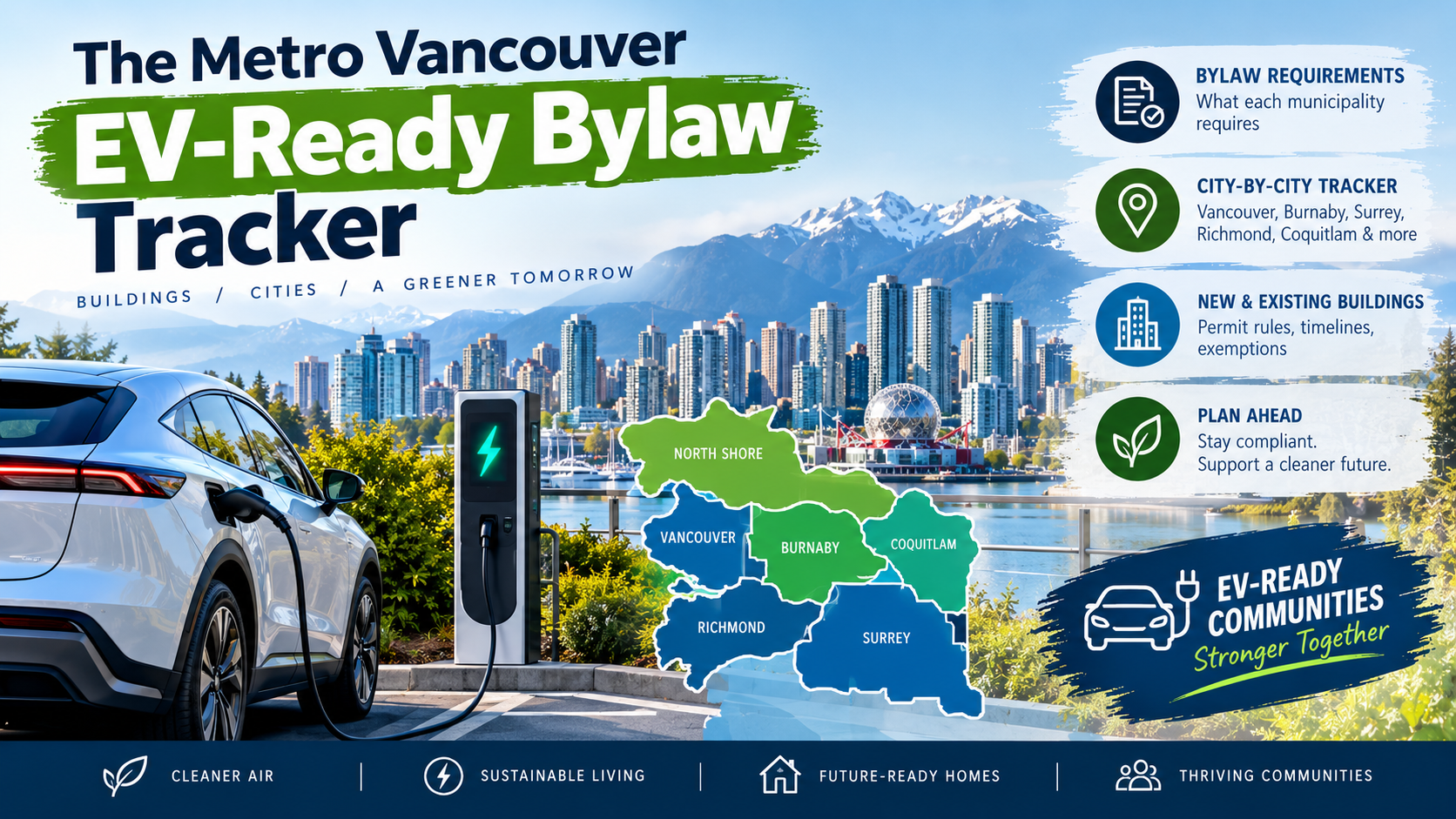
The Metro Vancouver EV-Ready Bylaw Tracker
What every municipality in our service area requires for EV-ready parking in new construction — who wants an outlet at every space, who settles for one per home, who only asks for conduit — and what that means for your electrical design.
The drawings for a Burnaby fourplex came to us with one EV outlet per unit. The designer had just finished a project in Coquitlam, where one energized outlet per dwelling is exactly what the bylaw asks for, and reasonably assumed the next city over would be similar. It isn't. Burnaby wants an outlet at every parking space provided for the new homes. Eight spaces, not four. Caught at drawing stage, that's an afternoon of redesign and a conversation about load management. Caught at final inspection, it's trenching.
That's the whole reason this tracker exists. Fifteen municipalities, at least four different definitions of "EV-ready," and bylaws that have changed three times in the past eighteen months. Here's where each one stands.
01First: it isn't in the BC Building Code
You'll find developer guides and charger-company blogs stating that the BC Building Code makes every new home 100% EV-ready. It doesn't. There is no province-wide EV-ready requirement in the Building Code at all.
What exists is a patchwork of local bylaws. The Province has said EV charging requirements fall outside the scope of the Building Act, which leaves municipalities free to require them through their own parking and zoning powers — and most Metro Vancouver municipalities have. By the count in Clean Energy Canada's January 2026 roadmap, roughly 33 local governments covering about 79% of BC's population now have EV-readiness bylaws of some kind. That roadmap pushed the province to adopt a single standard precisely because there isn't one.
So the honest answer to "is my new home required to be EV-ready?" is always the same: it depends entirely on which municipality issues your building permit. Which is what the table below is for.
02The tracker, city by city
Last checked: October 2026. Requirements apply to new development; most exclude visitor parking. Always confirm the current wording with the municipality at development or building permit stage.
| Municipality | New residential parking | Non-residential | Where the rule lives | Electrical permit from |
|---|---|---|---|---|
| Vancouver | Every space All residential spaces except visitor — including one- and two-family homes, laneway houses and suites | 45%; hotels and B&Bs 100%; car-share 100% plus a charger | Parking By-law No. 6059, s.4.14 | City |
| Burnaby | Every space All spaces for new dwelling units, except visitor and spaces serving existing units | 45% (all accessible spaces included; at least 10% or one space without load management); car-share 100% plus a charger | Zoning Bylaw, Part 7, s.1.5.3 | City |
| Surrey | Every space 100% of residential spaces | 20% | Zoning bylaw — confirm current section | City |
| City of North Vancouver | Every space 100% of residential spaces | 45% | Zoning Bylaw, 1995, No. 6700 | City |
| District of North Vancouver | Every space 100% of residential spaces | 45%; car-share spaces need a charger | Zoning Bylaw amendment, effective July 1, 2025 | District |
| West Vancouver | Every space Every residential space in new dwelling units, except visitor; labelled | Not identified — confirm | Zoning Bylaw No. 4662, s.142.10 | District |
| Richmond | Every space 100% of residential spaces | 45% | Zoning Bylaw 8500 — confirm current section | Technical Safety BC (city issues gas) |
| New Westminster | Every space 100% of residential spaces | Not identified — confirm | Zoning bylaw — confirm section | Technical Safety BC |
| Port Moody | Every space 100% of residential spaces | Not identified — confirm | Zoning bylaw — confirm section | Technical Safety BC |
| Squamish | Every space 100% of residential spaces (earlier rules used a shared-access formula for apartments) | Not identified — confirm | Zoning bylaw — confirm section | Technical Safety BC |
| Delta | Every space multi-unit and mixed-use (visitor exempt) · One per home single-detached, each duplex unit, each townhouse garage | 20% commercial, 5% industrial | Zoning Bylaw No. 7600, ss.8.5.12–8.5.13 | Technical Safety BC |
| Maple Ridge | Every space apartments and seniors housing · One per home detached through townhouse | At least 10% | Off-Street Parking and Loading Bylaw No. 7970-2023 | City |
| Coquitlam | One per home One energized outlet per dwelling unit (every space where spaces are fewer than units); designed to scale to 100% | Not identified — confirm | Zoning Bylaw (2018 amendment, Bylaw No. 4905) | Technical Safety BC |
| Port Coquitlam | Rough-in One space per dwelling unit with roughed-in Level 2 infrastructure — breaker, raceway, outlet box within 3 m | Not identified — confirm | Zoning Amendment Bylaw No. 4035 | Technical Safety BC |
| Whistler | Policy All residential spaces in new multi-family and mixed-use projects seeking rezoning | 25% (rezonings) | Green building policy for rezonings — not a blanket bylaw; confirm status | Technical Safety BC |
"Not identified" means we didn't find a non-residential requirement in the bylaw or the provincial guide — not that one definitely doesn't exist. Ask. And if your project is under the electrical-permit column marked Technical Safety BC, our city-by-city permits guide explains the split.
03Three kinds of "EV-ready" — and why the difference matters
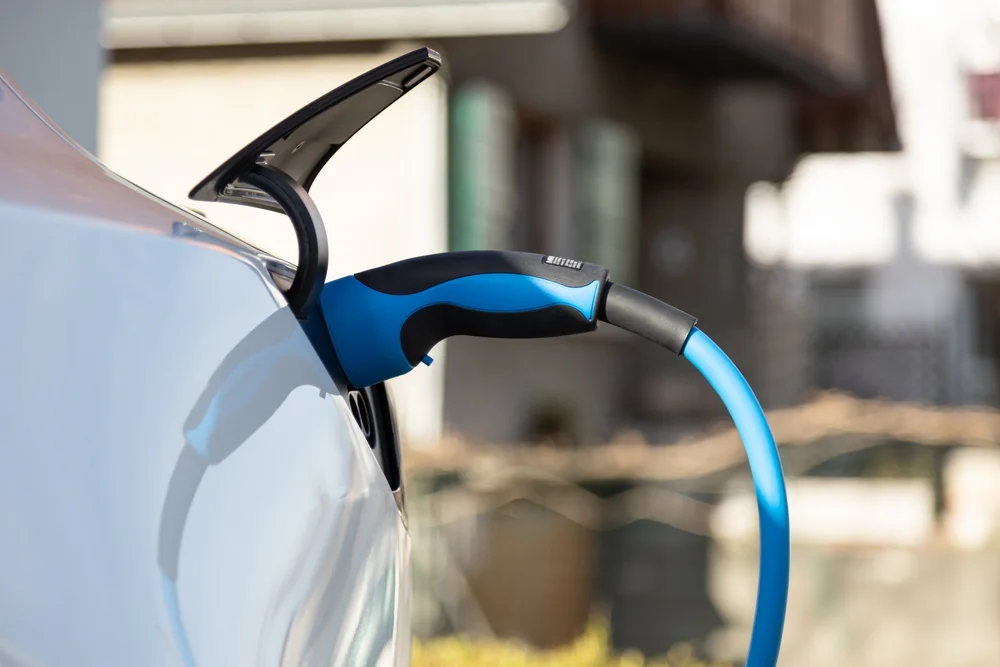
The phrase gets used as if it meant one thing. On a drawing, it means at least three.
An outlet at every space
An energized outlet capable of Level 2 charging at each residential parking space, usually labelled for EV use. The strictest standard and the most common in Metro Vancouver.
Vancouver · Burnaby · Surrey · Richmond · both North Vancouvers · West Vancouver · New Westminster · Port Moody · Squamish
One outlet per home
One energized Level 2 outlet per dwelling unit, even if the home has two or three spaces. The other spaces can stay unwired.
Coquitlam · Delta and Maple Ridge for lower-density housing
Roughed-in only
A breaker in the panel and raceway to an outlet box near the space — the pathway, not a live outlet. Cheapest at build, but someone still has to pull wire later.
Port Coquitlam
Why it matters to you: each standard puts a different amount of load on the service and costs a different amount at framing. A three-car garage in West Vancouver needs three outlets. The same garage in Coquitlam needs one. In Port Coquitlam it needs a breaker and a conduit run. Same house, three electrical budgets.
04What changed recently
If you last looked at this in 2024, three things are out of date.
- District of North Vancouver moved its EV-ready rules out of rezoning policy and into the zoning bylaw. Council adopted the amendment on January 27, and it took effect on July 1, 2025: 100% of residential spaces and 45% of non-residential.
- Maple Ridge adopted a new Off-Street Parking and Loading Bylaw No. 7970-2023 on December 16, 2025. Apartments and seniors housing now need every residential space EV-ready; detached homes through townhouses need at least one per unit; non-residential needs at least 10%. Applications already in the system aren't affected.
- Burnaby brought in a new zoning bylaw on July 1, 2026, and the EV rules now sit in Part 7, section 1.5.3. The core requirement is unchanged — every space for new dwelling units — but old section references in older guides no longer point anywhere.
Which is why the "last checked" date at the top matters. A bylaw tracker that doesn't carry one isn't really a tracker.
05The fine print that changes the design
Headline percentages are only half of it. These details are the ones that show up on our drawings.
- Visitor parking is usually excluded. Vancouver, Burnaby, West Vancouver, Coquitlam and Delta all carve it out explicitly. Don't wire it unless your municipality or your client asks.
- Vancouver has a load-limited alternative. In certain one- and two-family cases where the required outlet would push the home's calculated load too far, the city's Building By-law allows a labelled raceway from the panel to an outlet box in the garage or carport instead. Read the exact conditions in Part 10 of the Building By-law amendment before relying on it.
- Some cities set a performance floor. Delta's zoning bylaw defines Level 2 charging as a minimum 40-amp, 240-volt circuit delivering at least 12 kWh over an 8-hour overnight period per charger. Burnaby's technical bulletin calls for 208–240 V and a minimum 40-amp breaker.
- Load management is generally allowed. The provincial best-practice guide's model bulletin lets a single 40-amp circuit serve up to four vehicles under an energy management system — which is how 100% requirements stay affordable in apartments. Burnaby, unusually, requires a slice of its non-residential spaces to be without load management.
- Labelling counts. Most bylaws require the outlet to be labelled for EV charging. Inspectors check.
06Outlets aren't capacity — the part that catches builders
Here's where the bylaw and the electrical code meet, and it's the bit most planning-side guides skip.
A bylaw can require an outlet at every space. It can't make your electrical service bigger. In the load calculation under the Canadian Electrical Code, as adopted in BC, electric vehicle supply equipment is counted at 100% unless an energy management system controls it. Three 40-amp EV circuits in a new detached home is 120 amps of calculated load before the house has a kitchen.
Two code tools make "every space" workable. Under Rule 8-106(10), where an EV energy management system controls the chargers, the EV load is counted at the maximum the system allows. Under Rule 8-106(11), where the system monitors the service and controls the chargers in accordance with Rule 8-500, the EV load can be left out of the calculated load. Technical Safety BC sets out the acceptance requirements in its EVSE and EVEMS information bulletin.
Practically: decide on load management at design stage, not after the panel schedule is drawn. Otherwise you can find yourself specifying a bigger service than the house needs, or a sub-panel you didn't budget for. Our electrical planning report does that load math before anyone commits, and our post on charging an EV without overloading your panel covers the homeowner side.
07Who enforces what — the two maps don't line up
The EV-ready rule is a planning and zoning requirement. Your city's planning and building staff check that the outlets are on the drawings and present at final. But the wiring itself is electrical work, and that's inspected by whoever issues electrical permits where you are.
In seven municipalities that's the same city — Vancouver, Burnaby, Surrey, the City and District of North Vancouver, West Vancouver and Maple Ridge. In Coquitlam, Port Coquitlam, Port Moody, New Westminster, Richmond, Delta, Squamish and Whistler, the electrical permit and inspection come from Technical Safety BC. So in Coquitlam, the city requires the outlet and the province inspects it. Two files, two queues. Plan for both. Our post on EV charger permits city by city covers the charger installation side.
08Existing homes and stratas: what applies to you
Short version: if your home already exists, none of these bylaws force you to add anything. They apply to new development — and Burnaby's, for one, explicitly excludes new spaces serving existing dwelling units.
Where it gets interesting is the older strata building where five owners now have EVs and one shared parkade. That's a retrofit, and it's planned differently: an EV Ready Plan that sizes the building's electrical infrastructure for every stall, then load management so the building doesn't need a new service. BC Hydro has funded both the planning and the infrastructure through its rebate programs; amounts and eligibility change, so confirm current terms with BC Hydro before budgeting.

Our EV Ready Plan service is built for exactly this, and we've written about what an EV Ready Plan involves and what strata owners can and can't do with strata electrical work. For a single home, start with our EV charger installation page and our guide to EV charger installation costs.
09How to use this tracker
- Find your row, then call the city. Treat the table as the starting point, not the answer. Bylaws are amended between our updates.
- Count spaces, not homes — unless you're in a one-per-home municipality. That single difference is where most drawing errors come from.
- Put every outlet on the plans at development and building permit stage, labelled as EV.
- Decide on load management before the panel schedule. It changes the service size.
- Open the electrical permit with the right authority — the city in seven municipalities, Technical Safety BC in the other eight.
- Watch for in-stream rules. Maple Ridge's new bylaw, for example, doesn't apply to applications already submitted.
Designing a new home or building? Get the EV outlets right the first time.
Kato Electrical is a licensed and insured Vancouver electrician working across Metro Vancouver, Squamish and Whistler. We'll check your municipality's current EV-ready rule, design the outlets and load management into the service from day one, and permit it with the right authority.
Call (604) 330-5854 Book a design review10Frequently asked questions
Does the BC Building Code require new homes to be EV-ready?
No. There is no province-wide EV-ready requirement in the BC Building Code. EV-ready parking rules come from individual municipalities, which set them through their own zoning or parking bylaws. Most Metro Vancouver municipalities have one, but the standard varies — from an energized outlet at every residential parking space to one outlet per dwelling unit, or only roughed-in infrastructure. Check the bylaw for the municipality issuing your building permit.
Which Metro Vancouver cities require an EV outlet at every residential parking space?
As of October 2026, Vancouver, Burnaby, Surrey, Richmond, the City of North Vancouver, the District of North Vancouver, West Vancouver, New Westminster, Port Moody and Squamish require an energized Level 2 outlet at essentially every new residential parking space, usually excluding visitor parking. Delta and Maple Ridge apply the same standard to apartments and multi-unit buildings but require one outlet per home for lower-density housing. Confirm current wording with the municipality before designing.
What does EV-ready mean in Coquitlam and Port Coquitlam?
Coquitlam requires one energized outlet capable of Level 2 charging per dwelling unit, or every residential space where there are fewer spaces than units, with the infrastructure designed to scale to 100% later. Port Coquitlam requires one parking space per dwelling unit to have roughed-in Level 2 infrastructure — a 208 or 240 volt breaker in the panel connected by raceway to an outlet box within 3 metres of the space — rather than a live outlet. In both cities the electrical permit comes from Technical Safety BC.
Do EV-ready bylaws apply to existing homes?
No. The bylaws apply to new development, and Burnaby's explicitly excludes new parking spaces serving existing dwelling units. Owners of existing homes can add an EV charger at any time with an electrical permit, and existing strata buildings usually retrofit through an EV Ready Plan, which BC Hydro has supported through rebate programs whose amounts and terms change over time.
Does every EV-ready outlet need its own full-capacity circuit?
Not necessarily. Most municipal rules allow EV energy management systems, and the provincial best-practice guide's model bulletin lets one 40-amp circuit serve up to four vehicles under load management. Under the Canadian Electrical Code as adopted in BC, EV supply equipment is counted at 100% in the load calculation unless an energy management system controls it; where one does, Rules 8-106(10) and 8-106(11) reduce or remove the EV load from the calculation. Burnaby requires a portion of its non-residential EV-ready spaces to be without load management.
Who inspects EV-ready outlets in a new building?
Two authorities can be involved. The municipality's planning and building staff check that the required outlets appear on the drawings and are present at completion. The electrical wiring is inspected by whoever issues electrical permits: the city itself in Vancouver, Burnaby, Surrey, the City and District of North Vancouver, West Vancouver and Maple Ridge, and Technical Safety BC in Coquitlam, Port Coquitlam, Port Moody, New Westminster, Richmond, Delta, Squamish and Whistler.
How often do these EV-ready bylaws change?
Often enough to check every time. Since 2025 the District of North Vancouver moved its rules into its zoning bylaw, Maple Ridge adopted a new parking bylaw with expanded EV requirements, and Burnaby moved its EV provisions into a new zoning bylaw. Treat any tracker, including this one, as a starting point and confirm the current requirement with the municipality at development or building permit stage.
- EV Ready New Construction Requirements: A Best Practice Guide for BC Local Governments (Dunsky, January 2025, funded by BC Hydro) — municipal summary for Surrey, Richmond, City of North Vancouver, New Westminster, Port Moody and Squamish
- City of Vancouver — Electric vehicles (EV-ready requirements) and Parking By-law amendment, s.4.14
- City of Burnaby — Zoning Bylaw, Part 7, Parking, Loading and Mobility (s.1.5.3) and EV Charging Infrastructure Technical Bulletin
- District of West Vancouver — Zoning Bylaw No. 4662, Section 142.10 (within Section 140, Parking Regulations)
- UDI — District of North Vancouver EV charging infrastructure for new construction (adoption and effective date)
- City of Maple Ridge — Off-Street Parking and Loading Bylaw No. 7970-2023
- City of Coquitlam — Electric Vehicle Charging Infrastructure Requirements Guide
- City of Port Coquitlam — Electric Vehicles and Zoning Amendment Bylaw No. 4035
- City of Delta — Delta updates its electric vehicle charging regulations (Zoning Bylaw No. 7600, ss.8.5.12–8.5.13)
- Pique Newsmagazine — Whistler green building policy and EV-ready requirements for rezonings
- City of Surrey — Electric vehicle charger installation
- Technical Safety BC — Information Bulletin: EVSE and EV Energy Management Systems
Last checked October 2026. Bylaws change between updates; confirm the current requirement with the municipality before designing or building.