
Why Does My Breaker Keep Tripping? A Vancouver Winter Guide
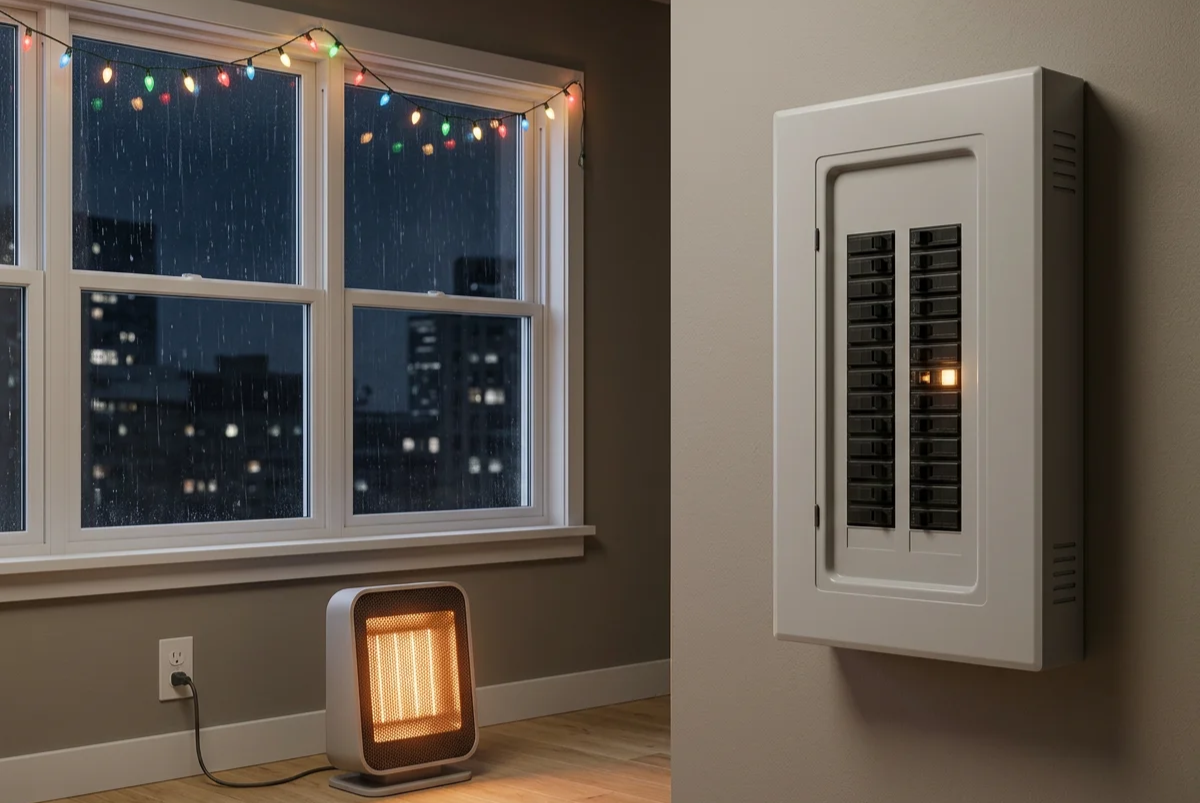
Every November our phones get busier with the same question: “My breaker keeps tripping, and it never used to.” The weather turns, the space heaters come out, the holiday lights go up, and the rain starts. For many Metro Vancouver homes, that combination is the first real stress test of the year.
A tripping breaker is not the problem. It’s your electrical system doing its job by cutting power before a wire overheats. The question is why it’s tripping, and whether the cause is something you can fix by unplugging a heater or something that needs a licensed electrician.
The three ways a breaker trips
Knowing which kind of trip you’re dealing with narrows down the cause fast.
Overload. You’re drawing more current than the circuit is rated for. The breaker usually trips after the circuit has been running for a while, often when a large appliance switches on. This is the most common winter cause.
Short circuit. A hot wire touches a neutral or ground wire, and current spikes instantly. The breaker trips right away, sometimes with a pop, and it may trip again the moment you reset it.
Ground fault or arc fault. GFCI and AFCI protection detects current leaking where it shouldn’t, or the electrical signature of arcing in a damaged wire or loose connection. Newer homes and renovated circuits have this protection built into the breaker or outlet, and it trips at levels a standard breaker would ignore.
Why it happens more in winter
Space heaters on shared circuits
A typical portable space heater draws about 1,500 watts, or roughly 12.5 amps on a 120-volt circuit. Most bedroom and living room circuits are rated for 15 amps, and for loads that run for hours, the safe working limit is lower than that. One heater can take up almost the whole circuit. Add a TV, a lamp, and a phone charger, and the breaker trips.
The fix is often just moving the heater to an outlet on a different circuit. If you’re running heaters every evening because a room is always cold, that’s worth talking to an electrician about. A dedicated heating circuit or a permanent heating solution is safer than relying on portable units long term.
Kettles, hair dryers, and morning rush hour
High-wattage appliances like kettles, toasters, hair dryers, and microwaves can each draw 1,000 to 1,800 watts. In many older Vancouver homes, especially kitchens that haven’t been rewired, several countertop outlets share one circuit. Running the kettle and toaster at the same time on a cold morning is a classic trip.
Holiday lights and Vancouver rain
Outdoor outlets are GFCI-protected for good reason. Water and electricity are a dangerous mix. But constant West Coast rain means moisture gets into extension cord connections, timers, and light strings, and the GFCI trips. This is protection working as designed, not a fault to bypass.
What helps: use cords and lights rated for outdoor use, keep connections off the ground and covered, and replace damaged strings rather than taping them. If an outdoor GFCI trips even when nothing is plugged in, the outlet itself or its box may be letting in water. That’s a job for an electrician.
Furnaces, heat pumps, and baseboard heaters
When central heating starts up for the season, any weakness in its circuit shows up. A heat pump or electric heating breaker that trips repeatedly may point to a failing component, a loose connection, or a circuit that was undersized for the equipment. Don’t keep resetting a heating breaker. Call your HVAC contractor or an electrician.
What you can safely check yourself
Before calling anyone, try this:
Note what was running when it tripped. If it happens every time the heater and microwave run together, you’ve likely found an overload.
Unplug everything on the circuit, then reset the breaker. Switch it fully to OFF before pushing it back to ON.
Plug things back in one at a time. If one specific appliance trips the breaker on its own, the appliance may be faulty. Our guide to how faulty appliances damage your electrical system explains what to look for.
Spread heavy loads across different circuits. Your panel directory, if it’s labelled, shows which outlets share a breaker.
Don’t go further than this. Don’t open the panel cover, don’t replace a breaker with a larger one, and never tape or hold a breaker in the ON position. A breaker that’s “too small” is usually protecting wire that can’t safely carry more current.
When to call an electrician
Stop resetting and book a licensed electrician if you notice any of the following:
The breaker trips immediately on reset, even with nothing plugged in
You smell burning or see scorch marks on an outlet, switch, or the panel
The breaker or panel feels warm to the touch
You hear buzzing or crackling from the panel or an outlet
Lights dim or flicker when large appliances switch on
Several different breakers have started tripping, not just one
Your home still has a fuse box, or you know it has aluminum or knob-and-tube wiring
A troubleshooting visit traces the cause. For hidden problems like loose connections or overheating breakers, thermal imaging can find hot spots before they turn into failures.
Is it time for a panel upgrade?
Sometimes repeated tripping is a sign your home has outgrown its electrical service. Many Metro Vancouver homes still have 100-amp service, which was sized for a very different household than one with an EV charger, a heat pump, an induction range, and a home office.
If your electrician’s load calculation shows you’re near capacity, adding circuits won’t solve the problem. A service upgrade, often to 200 amps, gives your home room to grow. We cover what’s involved, including cost ranges and the BC Hydro side of the process, in our panel and service upgrade guide. If the upgrade is part of a heat pump project, check BC Hydro and CleanBC for current rebate terms. Some programs have covered service upgrades for income-qualified homeowners.
If your home still has a fuse box, read why BC insurers are refusing to cover homes with fuse boxes before winter.
A note on permits
New circuits, breaker replacements, and panel upgrades require an electrical permit. In Vancouver, Burnaby, Surrey, the City and District of North Vancouver, and West Vancouver, the city issues electrical permits. In Richmond, Delta, New Westminster, and the Tri-Cities, the permit comes from Technical Safety BC. A licensed contractor like Kato pulls the permit under our own licence and arranges the inspection, so you don’t have to work out which authority applies.
Get your tripping breaker sorted before the cold sets in
A breaker that trips once after you plugged in too much is a nuisance. A breaker that keeps tripping is telling you something. Kato Electrical’s licensed electricians diagnose and repair tripping circuits across Vancouver, Burnaby, the North Shore, the Tri-Cities, and South of Fraser every week.
Book a troubleshooting visit or call 604 245 3433.