
EV Charger Installation in Vancouver: What Homeowners Need to Know in 2026
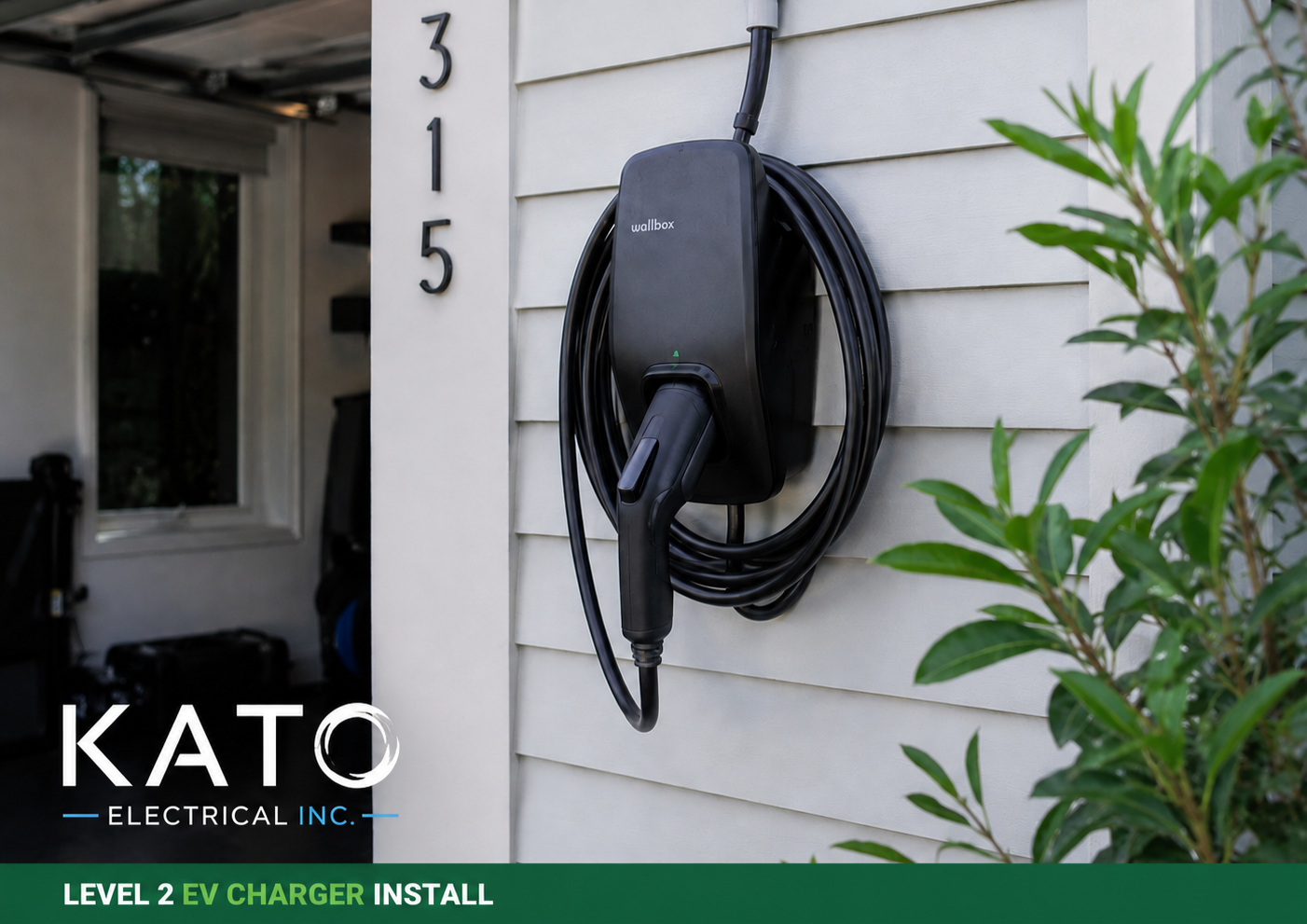
The new EV is in the driveway, and now there's a practical problem to solve: keeping it charged without driving to a public station every few days. For most Vancouver homeowners, the answer is a charger mounted at home — but the leap from "I want one" to "it's installed and working" runs through a few decisions that are easy to get wrong, especially in our older housing stock. Here's a straight-talk walkthrough of what actually goes into a home EV charger install in Vancouver and the Lower Mainland.
Level 1 vs. Level 2: which one do you actually need?
Every EV ships with a basic charging cord that plugs into an ordinary household outlet. That's Level 1, and it trickles power in slowly — enough to top up a plug-in hybrid overnight, or to keep a light-commute EV ticking along, but frustrating if you drive any real distance. Level 2 is the upgrade nearly everyone settles on. It runs on a 240-volt circuit — the heavier-duty kind your range or clothes dryer already uses — and refills a typical EV battery while you sleep instead of over a couple of days. Unless your driving is minimal, this is the setup worth planning for, and it's what the rest of this guide covers.
The permit question: yes, you need one
In British Columbia, a permanently wired Level 2 charger is permitted work, and the law requires a licensed electrical contractor to carry it out. There's a good reason behind that. The permit and the inspection that follows exist to confirm the new circuit is the right size, that your panel can actually carry the extra demand, and that nothing about the install becomes a hazard down the road. We fold the permit process into the job at Kato Electrical, so you're not left deciphering the City of Vancouver's electrical permitting on your own. It's tempting to have a charger thrown in without one, but an unpermitted install tends to surface at the worst times — a declined insurance claim, a snag during a home sale, or a circuit that was never sized for the load it's carrying.
Will your panel keep up?
This is the question that shapes everything else about your install, including the price. A Level 2 charger pulls somewhere in the range of 30 to 48 amps — a substantial, sustained draw. That matters a lot in Vancouver, where a huge share of homes (think older East Van bungalows, character houses on the West Side, the classic Vancouver Special) still run on 100-amp service that's already working hard to cover the furnace, range, and everything else. Before anything gets mounted on the wall, we run a load calculation to see what headroom you've actually got. When the numbers come up short, you're usually choosing between two paths: bumping the service up — commonly to 200 amps — or fitting a load-management device that lets the charger draw power only when the rest of the house isn't, sidestepping a full upgrade. We'll lay out which one fits your home and your budget rather than defaulting to the more expensive route.
What does it cost to install an EV charger in Vancouver?
There's no single sticker price, because a handful of variables move the number:
-How far the charger sits from your electrical panel — every extra meter of wiring and conduit adds to the job.
-Whether your panel needs upgrading, or whether load management gets you there for less.
-Where the unit goes — a tidy garage wall next to the panel is one thing; an outdoor mount that means opening up finished walls is another.
-The charger itself, from a basic hardwired unit to a smart model with a longer cable and app features.
A clean install with plenty of panel capacity lands at the affordable end. Add a service upgrade and a long cable run and it climbs. Rather than guess, we come out, look at your specific setup, and put a clear written quote in your hands before we touch anything.
Rebates in BC
British Columbia has run rebates that take a bite out of home charger costs through the CleanBC Go Electric program, and buildings with multiple units — condos and townhouse complexes — have historically qualified for separate, often larger incentives
If home is a condo or townhouse rather than a detached house, charging brings the strata and shared electrical infrastructure into the picture — a genuinely different process, and a slower one. We can help you put together the technical case to take to your strata council.
Why it pays to hire a licensed contractor
A charger isn't a small appliance you forget about. It's a heavy, repeated load on your home's wiring, drawing hard for hours at a time, often overnight while no one's watching. Installed properly, it'll run quietly for years. Installed badly, it's exactly the kind of fault that starts fires. Hiring a licensed electrical contractor gets you:
Work that's permitted and signed off against BC code.
A real assessment of your panel before anyone commits to a charger.
A warranty behind the job — and an install that keeps your home insurance intact.
Someone who'll talk through placement, the right unit, and leaving room for a second vehicle later.
As a licensed electrical contractor, Kato Electrical takes on EV charger work right across Vancouver and the Lower Mainland. With over a decade in the trade and fully insured work, every job is covered from the first site visit through to final inspection.
Frequently asked questions
How long will the install take? Most homes are done and charging the same day — . What stretches things out is a panel upgrade or a long cable run; if either applies to your place, we flag it up front and fold it into the quote, so the timeline is never a day-of surprise.
Can I just install it myself? Not legally in BC. A hardwired Level 2 charger needs a permit and a licensed electrician, and going the DIY route can leave you with voided insurance, no warranty, and a circuit nobody verified.
Does this mean a panel upgrade? Sometimes, sometimes not — it comes down to how much spare capacity your panel has. The load calculation we run answers that question, and a load-management device often makes an upgrade unnecessary.
Hardwired or plug-in — what's the difference? A plug-in charger feeds off a 240V outlet (a NEMA 14-50 is the common one); a hardwired unit connects straight into the circuit with no plug. Hardwired tends to win for outdoor spots and higher-amperage chargers. We'll point you to the right fit once we've seen the location.
Will it hold up through a wet Vancouver winter? It will. Outdoor-rated chargers are built for our climate, and for exterior installs we use weather-rated equipment and proper enclosures so rain and cold aren't a concern.
Ready to charge at home?
If a home charger is on your list for this year, start with a short assessment of your panel and the spot you have in mind. We take care of the permit, the installation, and the inspection — and you'll know the price before we begin.
Call us at 604 670 7172 or request a quote online → to get started.