
Pools, Hot Tubs and Multi-Car EV: The West Vancouver Electrical Load Problem
Why big North Shore homes run out of amps before they run out of garage, the two code routes that can save you a 400-amp upgrade, and what happens with BC Hydro when they can't.

The quote the homeowner showed us was for a 400-amp service. British Properties, a 1990s house on a 200-amp underground service, and a wish list that had grown the way West Vancouver wish lists do: pool heat pump, a hot tub on the lower terrace, and chargers for three cars because the third one was arriving in spring. The previous contractor had added up the nameplates, got a number well past 200, and stopped thinking. Which is understandable. It's also how people end up spending a five-figure sum on a problem a load-management device would have solved.
We're not saying the 400-amp upgrade is never the answer. Sometimes it absolutely is. But in West Vancouver it gets proposed far more often than it gets needed, and the expensive part of it — the BC Hydro side — is the part nobody can price until the utility looks. So here's how to think about it properly.
01Why West Vancouver hits the wall first
It isn't that West Vancouver homes are badly wired. Plenty are beautifully wired. It's that they collect loads.
Large lots, multi-car households, a long tradition of pools and hot tubs, and — increasingly — gas furnaces coming out and heat pumps going in. Add induction cooking, a sauna or steam shower, the occasional snow-melt system on a steep driveway, and every one of those lands on the same service that was sized when the house was built. Most residential services top out at 200 amps. A house can be enormous and still be on 200 amps.
The other West Vancouver factor is underground service. A lot of the neighbourhoods above the highway are fed underground, and that matters later, because changing an underground service costs more and takes longer than swapping an overhead drop. We'll get there.
02The arithmetic, roughly
Here's what a typical West Vancouver wish list looks like in connected nameplate load. This is not a code load calculation — the code applies demand factors that bring most of these numbers down considerably, which is exactly the point of the next section. It's just what's physically connected.
| New load | Typical dedicated circuit | How the code treats it |
|---|---|---|
| Level 2 EV charger — car 1 | 40 A at 240 V | 100% unless managed |
| Level 2 EV charger — car 2 | 40 A at 240 V | 100% unless managed |
| Level 2 EV charger — car 3 | 40 A at 240 V | 100% unless managed |
| Hot tub | 40–60 A at 240 V | Demand factors apply |
| Pool heat pump + pump | Varies by model — often 30–50 A combined | Demand factors apply |
| Connected, before the house itself | Roughly 190–250 A |
See the problem. On nameplate alone you've used a 200-amp service before a single light is on. That's the number the first contractor stopped at. The real calculation is more forgiving for the pool and the hot tub. It is not forgiving for the chargers.
03Why EV is the load that breaks the calculation
The Canadian Electrical Code, as adopted in BC, calculates a single dwelling's service using demand factors — it assumes, reasonably, that your range, dryer and hot tub aren't all running flat out at the same instant. Those assumptions are why a big house with a lot of appliances can still legally sit on 200 amps.
EV charging doesn't get that courtesy. Unless the chargers are controlled by an energy management system, electric vehicle supply equipment is added at 100%. And that's not the code being fussy. An EV charges for hours, in the evening, at full rated current — precisely when everything else in the house is on. It is the least diverse load you can own.
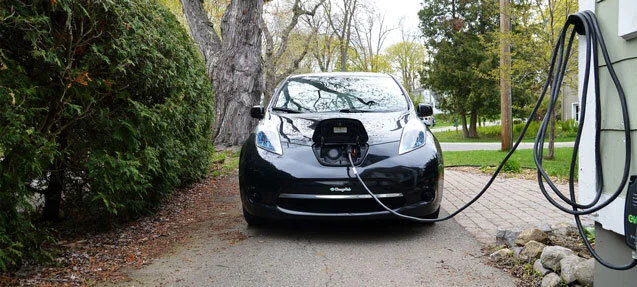
One charger on a 200-amp service is rarely a problem. Two is a conversation. Three is where nameplate arithmetic and code arithmetic both say no — unless you change how the chargers behave. We've written more on charging an EV without overloading your panel, and our EV charger installation page covers the install itself.
04Route 1: calculate from what your house actually uses
This is the one most homeowners have never heard of, and Technical Safety BC has published a specific information bulletin on it for detached single dwellings.
Rule 8-106(8) lets a qualified person calculate the load on an existing service by taking the home's actual maximum demand over the most recent 12 months — from utility data — and adding the new loads to that, instead of building the calculation up from scratch. A big house that's mostly empty on weekdays, or simply doesn't use what its theoretical calculation assumes, often has a lot more headroom on paper this way.
Two catches, and the second one is the expensive one:
- The service gets labelled with the newly determined kW calculation, noting it was based on Rule 8-106(8) and historical data, and the date it was done.
- Any further addition needs a fresh 12 months of history. In practice it's one use per year. Add the hot tub this way in March and then decide on the third charger in June, and you can't simply re-run it. Plan the whole wish list at once.
This is exactly why we push West Vancouver clients towards an electrical planning report before anything gets installed. The order you do things in determines which routes stay open.
05Route 2: let the chargers share
An EV energy management system (EVEMS) is a device — sometimes built into the chargers, sometimes a separate unit at the panel — that watches how much the house is drawing and throttles or pauses the chargers so the total never exceeds what the service can carry. The cars still charge overnight. They just don't all charge at full speed at the moment you're also running the hot tub heater and cooking dinner.
Technical Safety BC's EVSE and EVEMS information bulletin sets out the acceptance requirements, and it's worth knowing two things it makes clear. The qualified person installing it is responsible for verifying and testing that the system works and fails safe. And — this is the sentence that matters in West Vancouver — utility equipment isn't regulated by the BC Electrical Code, but may be affected by these systems. Your panel being happy doesn't automatically mean BC Hydro's transformer is.
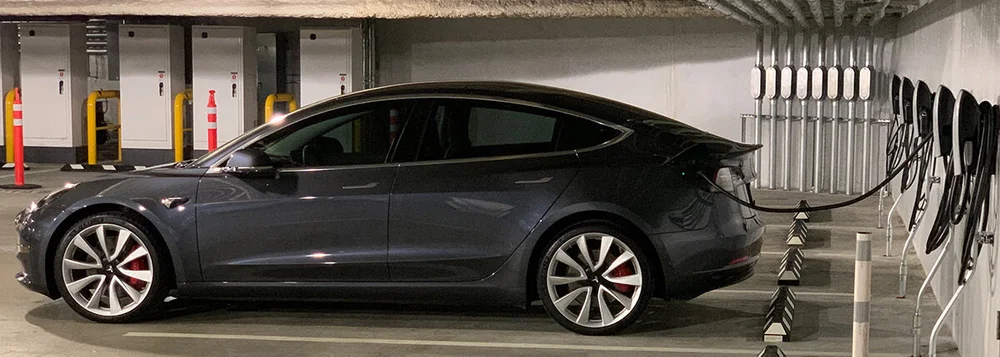
For a three-car household that mostly charges overnight, this is very often the right answer. It's also typically far cheaper than a service upgrade, and BC Hydro's EV charger rebate program has offered a top-up for power management devices — amounts and rules change, so confirm current eligibility on the BC Hydro site. Where a home also has a home automation system, load management can sometimes be extended to other flexible loads too, though only EV load management carries the specific code relaxations above.
06Building new? West Vancouver's EV-ready bylaw multiplies this
EV-ready rules aren't in the BC Building Code — they're municipal, and they vary. West Vancouver's are firm. Under Zoning Bylaw No. 4662, Section 142.10, for new dwelling units, every parking space for residential use — visitor parking excepted — must include an energized outlet capable of Level 2 charging and labelled for EV use.
Do that math on a new three-car garage. Three Level 2 outlets, each at 100% in the load calculation unless managed. On a new build with a pool and a hot tub, that's the point where designers either specify an EVEMS from day one or specify a larger service. Either is legitimate; deciding at design stage is what's cheap. Confirm with the District at permit intake how it wants energy management shown on the drawings. Our EV Ready Plan service is built for exactly this, and our post on EV charger permits city by city covers the permit side.
07When you genuinely need more than 200 amps
Sometimes neither route closes the gap. A large all-electric house with a heat pump, induction, a sauna, a pool and a hot tub can legitimately need more than 200 amps even with the chargers managed. Fine. Here's what actually changes when you go past it.
The metering changes. BC Hydro's fee schedule lists separate charges for services greater than 200 amps up to 400 amps, and services over 320 amps need current-transformer (CT) metering — a different, bulkier metering arrangement than the meter base you have now. Most residential "400-amp" upgrades are designed around that 320-amp threshold for exactly this reason.
The connection charge changes, and underground costs more. BC Hydro publishes minimum connection charges for these larger services, with underground noticeably higher than overhead. Treat those as floors, not quotes, and check the current schedule.
The transformer is the real unknown. Those published charges assume BC Hydro already has capacity available nearby. If the transformer serving your street — which in many West Vancouver neighbourhoods also serves several neighbours — doesn't have room for your new load, BC Hydro may need to extend or upgrade its own equipment, and that's priced by estimate. No electrician can tell you the answer standing in your garage. It's why we open the BC Hydro request early on any job heading past 200 amps.
On your side of the meter, a larger service means a new meter base, larger service conductors, and either a larger main panel or a main plus sub-panels. Expect it to cost several times a standard 200-amp upgrade, and expect the BC Hydro timeline, not ours, to set the schedule. Our service and panel upgrade page and our 100-to-200-amp breakdown cover the standard version of this job.
08Pools and hot tubs: the rules that don't change with service size
Whatever you decide about capacity, Section 68 of the BC Electrical Code — pools, tubs and spas — applies in full, and it's where inspections actually fail.
- Class A GFCI protection on the hot tub supply, and on other electrical equipment within 3 metres of the water unless it's suitably separated.
- Disconnect placement: outside the dwelling, in sight of the tub or lockable, and not within 1.5 metres of the water. Between 1.5 and 3 metres it needs GFCI protection or a permanent barrier. West Vancouver's tight terraced lots make this the rule we see broken most.
- Bonding: metal parts of a pool and the conductive infrastructure around it bonded together with copper, minimum No. 6 AWG. On a pool, the deck itself is part of the bonding conversation — sort it before concrete is poured, because it can't be fixed after.
- Receptacles no closer than 1.5 metres to the water.
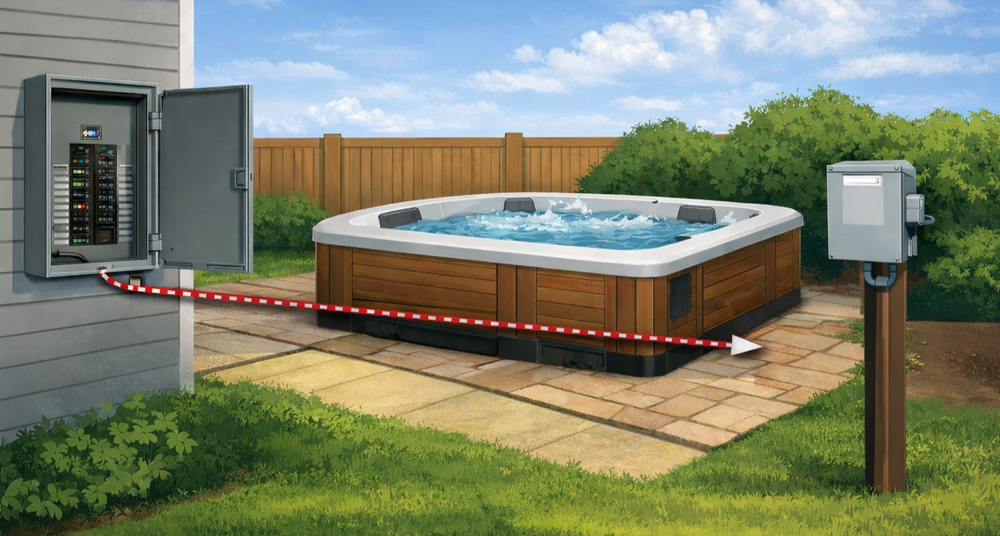
The detail is in our hot tub and spa wiring guide and on our hot tub installation page.
09The order to do things in
Almost every expensive outcome we see on the North Shore comes from doing these in the wrong order.
- Write the whole five-year wish list down first — every charger, the pool, the hot tub, the heat pump, any suite. Measured-demand calculations are effectively one per year; you want to spend it once.
- Pull 12 months of usage data before deciding anything. It may show you far more headroom than the theoretical calculation.
- Decide on EV load management before you decide on service size. It changes the answer.
- If you're going past 200 A, open the BC Hydro request immediately. The transformer question sets the schedule and possibly the budget.
- Lay out pool and hot tub disconnects and bonding before decks and concrete.
- Permit with the District of West Vancouver, not Technical Safety BC.
And the honest one: if your house is on 200 amps, you want a hot tub and one charger, and the measured demand shows headroom — you may need no service work at all. Get the numbers before anyone sells you the big job. If an existing circuit is already running hot or tripping, thermal imaging will tell you more than a guess will.
Quoted for a 400-amp upgrade? Get a second set of numbers.
Kato Electrical is a licensed and insured Vancouver electrician working across West Vancouver and the North Shore. We'll run the measured-demand and EVEMS options before anyone talks about service size, and handle the District permit and BC Hydro coordination if you do need more capacity.
Call (604) 330-9097 Book a load assessment10Frequently asked questions
Can a 200-amp service handle a pool, a hot tub and EV chargers?
Often a pool and a hot tub, yes, because the code applies demand factors to most household loads. Multiple EV chargers are what usually breaks it, because electric vehicle supply equipment is added to the load calculation at 100% unless it is controlled by an energy management system. One charger rarely causes trouble on 200 amps; two or three frequently do unless they are managed. A proper load calculation, ideally using your home's measured 12-month demand, is the only way to know.
What is an EV energy management system and is it allowed in BC?
Yes. An EV energy management system, or EVEMS, monitors how much power the home is using and throttles or pauses EV chargers so the total stays within the service capacity. Under Rule 8-106(10) the EV load is counted at the maximum the system allows, and under Rule 8-106(11), where the system monitors the service and feeders and controls the chargers in accordance with Rule 8-500, the EV load does not have to be counted in the calculated load. Technical Safety BC has published an information bulletin on the acceptance requirements, and the installer must verify and test that it works and fails safe.
What is the Rule 8-106(8) measured-demand method?
It lets a qualified person calculate an existing service's load by taking the home's actual maximum demand over the most recent 12 months, from utility data, and adding the new loads to it rather than building the calculation from scratch. The service must be labelled with the new kW calculation, a note that it was based on Rule 8-106(8) and historical data, and the date. Any further addition requires a fresh 12 months of history, so in practice it can be used about once a year — plan every new load together.
Does West Vancouver require EV-ready parking in new homes?
Yes. Under West Vancouver Zoning Bylaw No. 4662, Section 142.10, for new dwelling units every parking space for residential use, except visitor parking, must include an energized outlet capable of Level 2 EV charging and labelled for that use. On a new home with a multi-car garage, that significantly increases the electrical load unless an energy management system is used, so it should be settled at design stage. Confirm current requirements with the District at permit intake.
What changes if I need more than 200 amps from BC Hydro?
BC Hydro charges separately for services greater than 200 amps up to 400 amps, with underground connections costing more than overhead, and services over 320 amps require current-transformer metering. The published charges are minimums that assume capacity is already available nearby. If the transformer serving your street lacks capacity, BC Hydro may need to extend or upgrade its own equipment, priced by estimate. That transformer question usually sets the schedule, so the request should be opened early.
Who issues electrical permits in West Vancouver?
The District of West Vancouver issues its own electrical permits and carries out its own electrical inspections. It is one of seven municipalities in Kato Electrical's service area that do so, alongside Vancouver, Burnaby, Surrey, the City of North Vancouver, the District of North Vancouver and Maple Ridge. Work in West Vancouver is not permitted through Technical Safety BC.
Do I always need a service upgrade to add a hot tub or EV charger in West Vancouver?
No. Many homes on 200-amp service can add a hot tub and one EV charger with no service work, and many can add more chargers using an EV energy management system. A measured-demand calculation based on 12 months of real usage often shows more headroom than a theoretical calculation. Get the load assessment done before accepting a quote for a 400-amp upgrade.
- Technical Safety BC — Information Bulletin: EVSE and EV Energy Management Systems
- Technical Safety BC — Demand Factors and Use of Rule 8-106 8) for a Detached Single Dwelling
- District of West Vancouver — Zoning Bylaw No. 4662, Section 140 Parking Regulations
- BC Hydro — Charges and fees for electrical connections
- CSA Group — Canadian Electrical Code, Part I
Bylaws, utility fees and code interpretations change. Confirm current requirements with the District of West Vancouver, Technical Safety BC and BC Hydro before relying on them.