
Knob and Tube Wiring in Vancouver: What Homeowners Need to Know
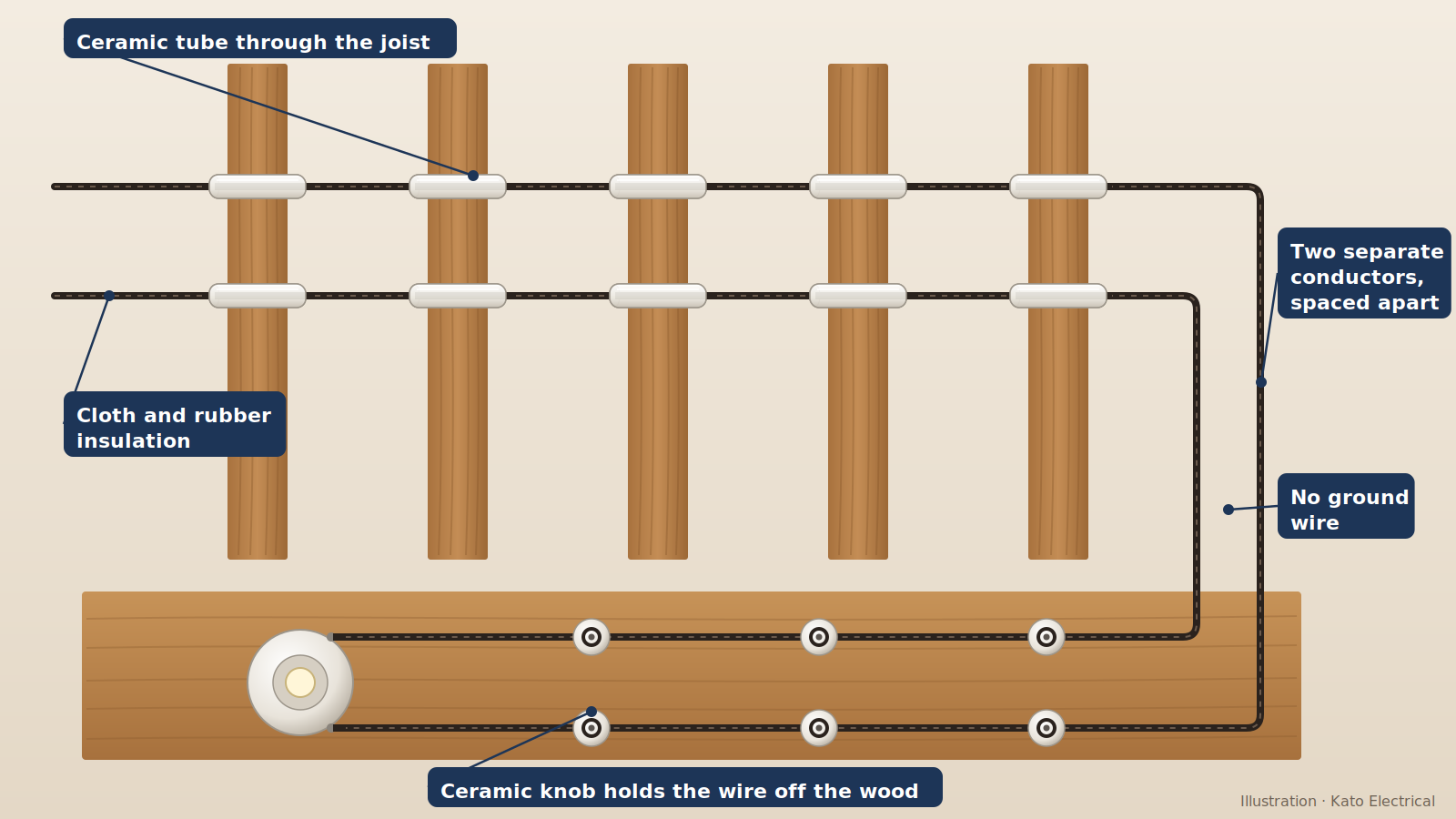
Diagram of knob and tube wiring: separate cloth-insulated wires running through ceramic tubes in the joists and held on ceramic knobs, with no ground wire
f you own a house in Vancouver built before the 1950s, there's a fair chance some knob and tube wiring is still in the walls. It shows up in Kitsilano and Grandview craftsman homes, Strathcona heritage houses, Mount Pleasant character homes, and older bungalows in East Van and New Westminster.
Most owners find out one of three ways: an insurer asks about it at renewal, a home inspector flags it during a sale, or a renovation opens a wall. In all three cases the question is the same. Is it dangerous, and what does it take to deal with it?
This guide answers that plainly, from the electricians who open these walls every week.
What knob and tube wiring is, and how to tell if you have it
Knob and tube was the standard way to wire a house in North America from the late 1800s until roughly the 1940s. Single copper conductors were run separately through the framing, held off the wood by ceramic knobs and passed through joists in ceramic tubes. The insulation is rubber and cloth, and there is no ground wire.
You may have it if you see any of these:
Ceramic knobs or tubes in an unfinished basement or attic, with single wires running a few inches apart.
Two-prong outlets throughout the house, especially in bedrooms and hallways.
A fuse panel, or a newer breaker panel with old cloth-covered wires feeding into it.
A house built before about 1950 that has never had a full rewire on record.
Many Vancouver homes have a mix. A previous owner may have rewired the kitchen and added a new panel, but left the original circuits running to the upstairs bedrooms or the ceiling lights. Only an inspection tells you how much is still live.
Why your insurer is asking about it
Insurers price risk, and an ungrounded, 80-year-old wiring system is a risk they can't see. Policies vary a lot between companies, but most fall into one of these responses:
Decline to write a new policy until the knob and tube is removed.
Insure with conditions, such as a higher premium or a deadline to replace it.
Ask for an electrical inspection first, then decide based on what the electrician finds.
Insurance won't pay for the replacement itself. What it will usually want is paperwork: a written assessment from a licensed electrician describing what's still live, its condition, and what's been replaced.
If you're buying an older home, call your insurer before your subjects come off. Finding out after closing that you can't get coverage is the worst time to learn it.
Is knob and tube actually dangerous?
Original, untouched knob and tube in good condition is less dangerous than its reputation. The real problems come from age and from what's been done to it since.
These are the issues we find most often in Vancouver homes:
Brittle insulation. After 80 to 100 years, the rubber and cloth covering can crack and flake off, especially where wires run through hot attics.
Buried in insulation. Knob and tube was designed to shed heat into open air. When blown-in or batt insulation is packed around it during an energy retrofit, the wires can overheat.
Amateur splices. Decades of DIY additions often mean modern cable spliced onto old conductors with tape, outside any junction box.
Overloaded circuits. These circuits were sized for a few lights and a radio. Space heaters, microwaves and window AC units push them past what they were built for, and an oversized fuse can hide it.
No ground. Without a ground path, you can't safely use three-prong devices, and you lose protection that modern electronics and appliances expect.
So the honest answer is that it depends on condition. Wiring that's intact, unaltered and lightly loaded may be stable. Wiring that's been insulated over, spliced into or overloaded should be dealt with soon.
Your options: full rewire, partial rewire, or leave it
There are three realistic paths, and the right one depends on condition, your insurer, and your renovation plans.
Full rewire. Makes sense when your insurer requires removal, the wiring is deteriorated, or you're renovating anyway. It's the biggest job, but it settles the question for good.
Partial rewire. Makes sense when most circuits are already updated and only a few knob and tube runs remain. It's a smaller job, as long as your insurer accepts what's left.
Leave it and monitor. Only makes sense when the wiring is intact, unaltered, and your insurer accepts it after an inspection. It costs nothing now, but it may come up again at renewal or resale.
A typical replacement follows the same sequence:
Inspection and assessment. We trace which circuits are still knob and tube, check condition, and write it up in a form you can hand to your insurer.
Scope and quote. You get a fixed scope: which circuits are replaced, whether the panel needs upgrading, and what wall access is needed.
Permit. We pull the electrical permit with the right authority for your city (see the next section).
Rewiring. New cable is fished through existing walls and ceilings where possible, using small access holes rather than opening whole walls.
Inspection. The permit inspector reviews the work before walls are closed up.
Patching. Access holes are patched. Plaster walls in older homes take more care here, so plan for it in your budget. (done by others)
If you're already planning a kitchen, bathroom or basement renovation, do the rewire at the same time. Open walls make the job faster and cheaper.
Who issues the electrical permit in your city
A knob and tube replacement needs an electrical permit, and in Metro Vancouver the permit doesn't always come from Technical Safety BC. Several cities issue their own.
In Vancouver, Burnaby, Surrey, the City and District of North Vancouver, and West Vancouver, your city issues the electrical permit.
In Richmond, Delta, New Westminster, Coquitlam, Port Coquitlam and Port Moody, the permit comes from Technical Safety BC.
Richmond issues its own gas permits but not electrical ones, which catches a lot of people out. Electrical work in Richmond goes through Technical Safety BC.
Whoever issues the permit, the work must be done by a licensed electrical contractor, and the inspector checks it before walls are closed. A permitted rewire also gives you the paper trail your insurer and any future buyer will ask for. For more detail, see our [city-by-city guide to electrical permits in Metro Vancouver]
How we quote a knob and tube replacement
We don't publish a flat price for knob and tube work, because no two older homes are wired the same way. Every quote follows an on-site inspection, so you get a fixed scope for your house rather than a guess.
What shapes the scope of the job:
How much is still live. Many homes were partly updated decades ago.
Wall type. Lath and plaster takes longer to fish wire through and to patch than drywall.
Access. An open basement and attic make runs faster. Finished basements and tight crawlspaces add time.
Panel capacity. Homes still on fuses or 60 or 100 amp service often need a panel upgrade at the same time.
Patching and finishing. Budget separately for repairing access holes, especially in heritage plaster. (done by others)
Aluminum wiring: the other older-home question
If your house was built or renovated between the mid-1960s and the late 1970s, the issue may be aluminum branch wiring rather than knob and tube. Insurers ask about both.
Aluminum wire itself isn't the problem. The risk sits at the connections, where aluminum expands, contracts and oxidizes differently from copper. Over time, terminations at outlets, switches and fixtures can loosen and overheat.
Unlike knob and tube, aluminum wiring doesn't always need to come out. Remediation usually means one of two things:
Repairing the connections with devices and connectors approved for aluminum, at every outlet, switch and junction.
Replacing the circuits with copper, often done room by room during renovations.
An inspection tells you which route fits your house and gives your insurer the documentation it's looking for.
Frequently asked questions
Is knob and tube wiring illegal in BC? No. Existing knob and tube isn't illegal to have in your home. It can't be used for new work, though, and insurers may require it to be replaced before they'll cover the house.
Can I sell a house with knob and tube wiring? Yes, but buyers' inspectors will flag it and buyers will need insurance. Expect it to come up in negotiations. A recent inspection report, or proof of a permitted rewire, makes the sale smoother.
Do I have to replace all of it at once? Not always. If most circuits are already updated, replacing the remaining runs may satisfy your insurer. Check what your insurer will accept before you commit to a scope.
How long does a knob and tube rewire take? A partial rewire can take a few days. A full rewire of a typical house usually takes one to two weeks of electrical work, plus inspection and patching time.
Can I stay in my house during the rewire? Usually, yes. We work through the house in sections so you keep power in most rooms each day.
Do I need a permit to replace knob and tube wiring? Yes. The permit comes from your city in Vancouver, Burnaby, Surrey, North Vancouver and West Vancouver, and from Technical Safety BC elsewhere in Metro Vancouver.
Can I add insulation to my attic if I have knob and tube? Not over live knob and tube. The wiring needs open air to shed heat. Have it assessed, and replace the attic runs before any insulation goes in.
Not sure what's behind your walls?
Book a knob and tube inspection with Kato Electrical. We'll trace what's still live, tell you plainly whether it needs to come out, and give you a written assessment you can send to your insurer.
Our electricians are Red Seal certified and licensed in BC. Kato carries $5M in liability insurance and a clear WorkSafeBC record, with more than 10 years in the trade across Vancouver and the Lower Mainland.
Call (604) 239-3084
info@katoelectrical.com
Monday to Friday, 8:00 AM – 4:00 PM
1179 Grant Street, Vancouver, BC