
Hot Tub Electrical Permits and Requirements Across Metro Vancouver
Hot Tub Electrical Permits and Requirements Across Metro Vancouver
Yes, you need a permit. Who issues it depends on your city. And whether your panel can take it is the question that actually sets the budget.

Delivery was booked for a Saturday. The tub was sitting on a flatbed in a New Westminster driveway, the deck was built, and the homeowner called us Thursday afternoon asking if we could "just run the line" before the weekend. We could run the line. What we couldn't do was open a permit with the province, get an inspector out, and have the disconnect placed correctly on a deck that had been framed with no thought to where it would go — all in forty-eight hours. The tub sat covered for eleven days. Nothing about that was unusual. It's most weeks in summer.
So here's the whole picture: the permit, who issues it in your city, what the code actually requires, and the one placement rule inspectors fail installs on.
01Do you need a permit? Yes — here's the one grey area
A hardwired hot tub is a new branch circuit. New branch circuits require an electrical permit under BC's Safety Standards Act, regardless of whether the tub is a pre-manufactured package or field-assembled, and regardless of which city you're in. There's no square-footage exemption and no "it's outdoors" exemption. If a contractor tells you otherwise, ask them who they think is going to inspect it.
The grey area is the 120-volt "plug-and-play" tub. If you're plugging a cord-connected unit into an existing, properly GFCI-protected outdoor receptacle that was itself permitted and inspected, you're using an existing circuit, and in most jurisdictions that on its own doesn't trigger a new permit. The moment anyone installs a new receptacle for it, runs a new circuit, or converts the tub to 240 volts — which is most of them, eventually, because 120-volt tubs heat slowly — you're back in permit territory. When in doubt, ask the authority. It's a phone call, not a project.
02Who issues your hot tub electrical permit: city by city
This is where Metro Vancouver catches people. Under the Safety Standards Act, some municipalities run their own electrical inspection programs and the province handles the rest. A hot tub is one permit, but which office holds it depends on where you live.
| City | Electrical permit & inspection |
|---|---|
| Vancouver | City — own Electrical By-law |
| Burnaby | City |
| Surrey | City |
| City of North Vancouver | City |
| District of North Vancouver | District |
| West Vancouver | District |
| Maple Ridge | City |
| Coquitlam | Technical Safety BC |
| Port Coquitlam | Technical Safety BC |
| Port Moody | Technical Safety BC |
| New Westminster | Technical Safety BC |
| Richmond | Technical Safety BC (city issues gas) |
| Delta | Technical Safety BC |
| Squamish | Technical Safety BC |
| Whistler | Technical Safety BC |
Seven self-permitting, eight through the province. Richmond is the one that trips people: it's delegated for gas and issues its own gas permits, but electrical still goes to Technical Safety BC. Our city-by-city electrical permits guide goes deeper on each one, and this post covers what the permits actually cost.
Practically: in the eight provincial municipalities, your electrician opens the file with Technical Safety BC and books the inspection there. The city has no window into that queue and can't tell you where you are in it. Which is why our New Westminster homeowner's Saturday delivery became a Tuesday-week soak.
03What the BC Electrical Code actually requires
The code side is the same in every city. Section 68 of the current BC Electrical Code — which adopts the Canadian Electrical Code with BC amendments — covers pools, tubs and spas, and it's specific in the way only a section written after a lot of bad outcomes can be.
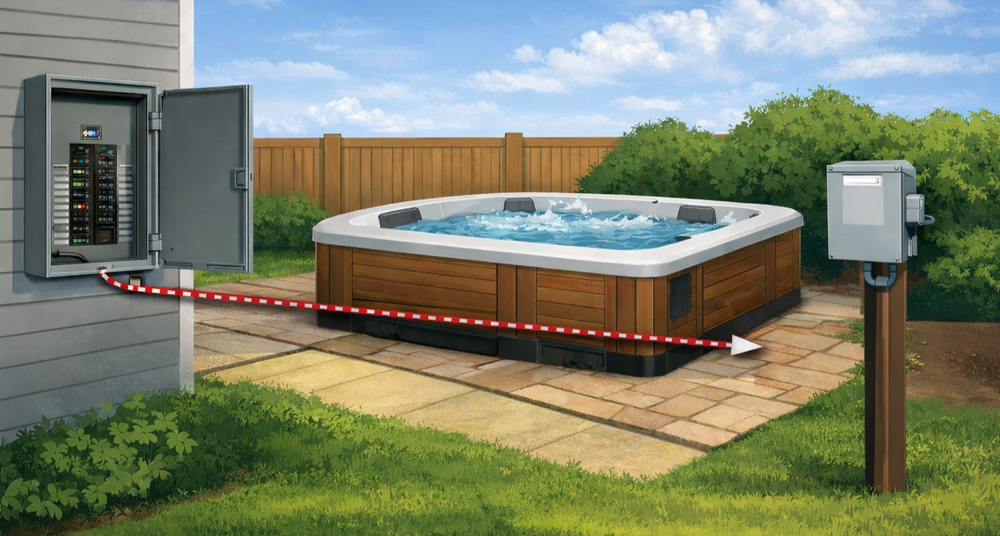
- A dedicated 240-volt circuit, sized to the manufacturer's nameplate — typically 40 to 60 amps. Nothing else on it. The tub's own installation manual is a code document here; inspectors read it.
- Class A GFCI protection for the tub supply. Usually a GFCI breaker in the panel or in the spa disconnect. Some manufacturers build it into the tub; the label will say so, and you still need to confirm it's actually protected at the end.
- A disconnect outside the dwelling unit, readily accessible, either in sight of the tub or lockable — and placed according to the distance rules in the next section. This is the one people get wrong.
- Receptacles no closer than 1.5 metres to the water. Existing outdoor plugs within that zone are a problem, not a convenience.
- Other electrical equipment within 3 metres of the water — pumps, lighting, a heat pump condenser that happens to be nearby — generally needs GFCI protection unless suitably separated.
- Bonding of the metal parts of the tub and the conductive infrastructure around it, so everything sits at the same potential. Our post on electrical grounding in household wiring explains why that matters near water.
- An outdoor-rated wiring method — conduit or approved outdoor cable, with a four-wire feed (two hots, neutral, ground) on almost every modern 240 V tub.
None of that is exotic. It's also not a Sunday-afternoon job, and a tub that fails inspection because one of those was skipped is a tub you can't legally use. Our hot tub electrical installation page covers the service side, and we went through the wiring in more depth in all about hot tubs and spa wiring.
04The disconnect rule inspectors fail installs on
If there's one paragraph in this article to read twice, it's this one, because the disconnect placement rule is the single most common reason a hot tub installation fails first inspection in our experience — and it's usually the deck builder's fault, not the electrician's.
The disconnect has to be outside the house, readily accessible, and either within sight of the tub or lockable when it isn't. So far, simple. The part that bites: it must not be within 1.5 metres of the water. If it lands between 1.5 and 3 metres from the tub, it has to be GFCI-protected or sit behind a permanent barrier between it and the water. Past 3 metres, the distance rule relaxes but the in-sight-or-lockable rule still applies.
Think about what that does to a typical backyard. A small deck built tight to the house, tub in the corner, the obvious wall for the disconnect is right beside it — inside 1.5 metres. Fail. Or the deck's built with a privacy screen that blocks line of sight, and the disconnect ends up around the corner without a lock. Fail. We've moved disconnects on decks that were finished, stained and furnished because nobody drew the 1.5-metre circle on the plan.
The fix costs nothing if it happens on paper: decide the tub's position, draw a 1.5 m radius around the water's edge, and put the disconnect just outside it, in line of sight, before the deck framing goes up. We install the disconnect and GFCI breaker as part of the job — details on our breakers and safety switches page — but we can only put it where the layout allows.
05The 100-amp tipping point
Here's where the money actually is, and it has nothing to do with your city.
A hot tub is a 40-to-60-amp appliance that runs a heater and pumps, often at the same moment your kitchen range, dryer and furnace blower are also running. On a home with a 200-amp service, that's rarely a problem. On the 100-amp service that most 1960s-through-1980s Lower Mainland homes still carry — especially with a panel already full of tandem breakers — the load calculation frequently doesn't close.
Two outcomes. Either the existing service holds and we add the circuit — sometimes via a small sub-panel near the tub, which we've covered in when a sub-panel makes sense. Or you need a service and panel upgrade, which in our experience lands in the $3,000 to $6,000 range in Metro Vancouver depending on service size, meter base condition and utility configuration. Any change at the service entrance also means BC Hydro is involved, and that coordination is routinely the longest item on the schedule — longer than the permit, longer than the work. Our breakdown of a 100 to 200 amp service upgrade walks through that decision.
06Deck, structure and enclosure: the permits people forget
The electrical permit is the one everyone eventually remembers. Two others get missed.
A portable tub sitting on a pad at grade generally doesn't need a building permit. A tub on a deck is a different question: a filled tub with four people in it is a serious concentrated load, and the deck may need engineering or a building permit depending on your municipality's rules and the deck's design. And some municipalities have pool or spa enclosure requirements — fencing, or an approved lockable safety cover as an alternative. These are planning and building matters, not electrical ones, and they vary; confirm them with your municipality at the same time you confirm the electrical authority. Two phone calls instead of one.
07Strata and condo: a short, honest note
If you're in a strata — a townhouse with a private patio, say — the electrical permit works the same way, but you'll need strata approval first, and the load calculation runs against your unit's feed, not a whole-house service. Some strata electrical is on shared infrastructure that no individual owner can touch. We wrote a full guide to what you can and can't do with strata and condo electrical work; read that before you buy the tub, not after.
08Pre-delivery checklist
Most of the grief we see is sequencing. Do these before the tub is ordered, or at least before it's on the truck.
- Get the manufacturer's electrical spec — amperage, GFCI requirement, whether it's 120 or 240 V. That document drives everything below.
- Load calculation done, with the service-upgrade or sub-panel decision made rather than deferred.
- Electrical file open with the right authority — city in the seven self-permitting municipalities, Technical Safety BC in the other eight.
- BC Hydro engaged if the service entrance is changing. Earliest possible.
- Disconnect location drawn on the plan — outside the 1.5 m circle, in sight or lockable — before deck framing starts.
- Deck engineering and enclosure rules confirmed with the municipality.
- Existing outdoor receptacles within 1.5 m of the tub identified and dealt with.
- Inspection booked with realistic lead time for the authority you're actually dealing with — a week or more in summer is not unusual.

09What it costs, and what actually goes wrong
A straightforward hot tub circuit — dedicated 240 V feed, GFCI breaker, disconnect, outdoor-rated wiring, permit and inspection — generally runs in the low thousands in our experience, with two swing factors: distance from the panel (longer runs need heavier wire and more conduit) and whether the service needs upgrading, which can double the number. Every yard is different; treat that as a planning bracket. Our outdoor living and hot tub guide puts the electrical in context with the rest of the project.
What goes wrong is rarely the wiring:
- Disconnect inside the 1.5 m circle or out of sight without a lock. Fails inspection, moves after the deck's finished.
- Wrong GFCI. A standard breaker where a Class A GFCI was required, or a GFCI that nuisance-trips because the tub's heater and the breaker weren't matched. Our breaker guide covers the difference.
- Undersized wire on a long run. Voltage drop across sixty feet of the wrong gauge means a heater that never quite gets there and a control board that fails early.
- No bonding. Skipped because it's invisible when done and invisible when not — until an inspector or a shock finds it.
- Assuming one permit office. In eight of our fifteen municipalities, it isn't the city.
- Wiring without a permit. It surfaces at sale, it gives an insurer grounds to deny a claim, and — because a tub is water plus electricity — it's the one place we'd beg you not to gamble. Our insurance inspection page covers what that conversation looks like later.
And the honest note: if your home is on 200-amp service with room in the panel, the tub is going within reasonable distance of it, and your deck layout leaves room for the disconnect, this is a one-day job with one inspection. Not every hot tub needs a service upgrade. Get the load calculation before you assume it does. If an existing tub is tripping breakers or won't hold heat, that's a troubleshooting visit, not a rewire.
Tub on order? Get the circuit in before it arrives.
Kato Electrical is a licensed and insured Vancouver electrician serving the Lower Mainland from Squamish to Maple Ridge. We handle hot tub electrical end to end — load calculation, permit with the right authority, GFCI, disconnect, bonding and inspection — and we'll tell you up front if your service can't carry it.
Call (604) 330-5854 Book a hot tub estimate10Frequently asked questions
Do I need an electrical permit to install a hot tub in Metro Vancouver?
Yes, for any hardwired tub. A hot tub is a new dedicated 240-volt branch circuit, typically 40 to 60 amps, and new circuits require an electrical permit under BC's Safety Standards Act in every municipality. The only grey area is a 120-volt plug-and-play tub connected to an existing, properly GFCI-protected outdoor receptacle that was itself permitted — using an existing circuit usually does not trigger a new permit on its own. The moment a new receptacle or circuit is installed, a permit is required.
Who issues the electrical permit for a hot tub in my city?
It depends where you live. Vancouver, Burnaby, Surrey, the City of North Vancouver, the District of North Vancouver, West Vancouver and Maple Ridge issue their own electrical permits and send their own inspectors. In Coquitlam, Port Coquitlam, Port Moody, New Westminster, Richmond, Delta, Squamish and Whistler, the electrical permit comes from Technical Safety BC. Richmond is delegated for gas and issues its own gas permits, but its electrical still goes to the province.
Where does the hot tub disconnect have to be located?
Outside the dwelling unit, readily accessible, and either within sight of the tub or lockable when it is not. It must not be within 1.5 metres of the water. If it is placed between 1.5 and 3 metres from the tub, it must be GFCI-protected or separated from the water by a permanent barrier. This placement rule is the most common reason a hot tub installation fails first inspection in our experience, and it is almost always fixable for free at the planning stage by drawing a 1.5-metre radius around the tub before the deck is framed.
Will my 100-amp panel handle a hot tub?
Sometimes, but it is the service size most likely to fail the load calculation. A hot tub adds 40 to 60 amps of load that often coincides with a range, dryer and furnace running. Homes on 200-amp service rarely have a problem; homes on 100-amp service with a full panel frequently need a service upgrade, which in our experience runs $3,000 to $6,000 in Metro Vancouver, or a sub-panel where the existing service has capacity. Get the load calculation done before ordering the tub — it is a short assessment and it sets the real budget.
Does a hot tub need GFCI protection in BC?
Yes. Section 68 of the BC Electrical Code requires Class A ground-fault circuit-interrupter protection for the hot tub supply, usually provided by a GFCI breaker in the panel or in the spa disconnect. Some manufacturers build GFCI protection into the tub itself and label it accordingly, but the installer still has to confirm the completed installation is protected. Other electrical equipment within 3 metres of the water generally needs GFCI protection as well unless it is suitably separated.
Do I need a building permit for a hot tub as well as an electrical permit?
A portable tub sitting on a pad at grade generally does not need a building permit. A tub on a deck is a structural question, because a filled tub with occupants is a heavy concentrated load, and the deck may need engineering or a building permit depending on your municipality and the deck design. Some municipalities also have pool or spa enclosure requirements, with an approved lockable safety cover sometimes accepted as an alternative to fencing. Confirm both with your municipality at the same time you confirm the electrical authority.
Can the electrical be installed before the hot tub is delivered?
Yes, and it is the best way to do it. With the manufacturer's electrical specification in hand, the dedicated circuit, GFCI breaker, disconnect and wiring can all be installed and inspected in advance, so delivery day is a final hookup rather than the start of a wait. Rough-in inspection lead times of a week or more are not unusual in summer, so the earlier the file is opened with the correct authority, the better.
- Technical Safety BC
- CSA Group — Canadian Electrical Code, Part I, Section 68 (Pools, Tubs and Spas)
- BC Laws — Safety Standards Act
- City of Vancouver — Electrical By-law and permits
- BC Hydro
Municipal bylaws, fees and processes change. Confirm current requirements with the relevant authority before relying on them.