
Why Are Power Surges Dangerous For Your Home And Your Belongings?
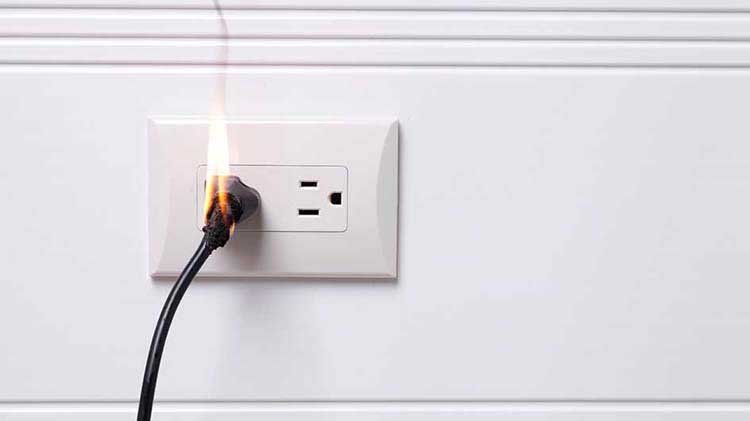
The next BC Hydro outage isn't a matter of if. It's a matter of whether your home is ready when power comes back. Call Kato Electrical: (604) 239-3084
Why Are Power Surges Dangerous For Your Home And Your Belongings?
A homeowner in East Vancouver contacted us the week after a BC Hydro outage last autumn. The outage itself was about three hours. When power came back on, the restoration surge took out a refrigerator, two laptops, and a 65-inch television — all in one hit. Total replacement cost somewhere north of $4,000. She had a power bar on the laptops. Thought she was covered. She wasn't.
We get this call more than you'd think. And here's what makes it worse: in most cases, the whole thing was preventable for a few hundred dollars. But almost nobody thinks about surge protection until after something expensive dies. Maybe that's you right now, reading this because something just happened. Maybe it's not — maybe you're being smart about this before the next storm rolls in off the Pacific and drops a tree on a BC Hydro transformer somewhere between your home and the substation. Either way, you're in the right place.
What Are Power Surges?

Your home's wiring runs on 120 volts in Canada. Not exactly 120 — it fluctuates slightly throughout the day, and that's completely normal. The appliances and electronics in your home are designed to handle that variation. What they are not designed to handle is a sudden, sharp spike well above that threshold. That spike is a power surge.
Think of it like water pressure. Your plumbing is designed for a certain pressure range. A momentary burst of pressure three or four times higher than normal won't burst the pipes — probably — but it will absolutely stress the joints, seals, and valves every time it happens. Your home's electrical system works the same way. The wiring itself usually survives. The microprocessors, capacitors, and sensitive circuit boards inside your appliances often don't.
Modern electronics are particularly vulnerable because they run at such low internal voltages. The microchip inside your refrigerator's control board might operate at 3 or 5 volts internally. When a 400-volt spike hits the circuit, the step-down components can only do so much. What gets through is enough to cause immediate failure — or, just as commonly, enough to cause invisible degradation that shortens the component's life significantly without killing it outright.
There are two flavours of surge worth understanding. The dramatic kind — a single large event from lightning or a grid fault — gets most of the attention. But the quieter kind, small repetitive spikes from appliances cycling on and off inside your own home, is responsible for more cumulative damage than most homeowners realise. More on that shortly.
↑ Back to topWhat Causes A Power Surge?
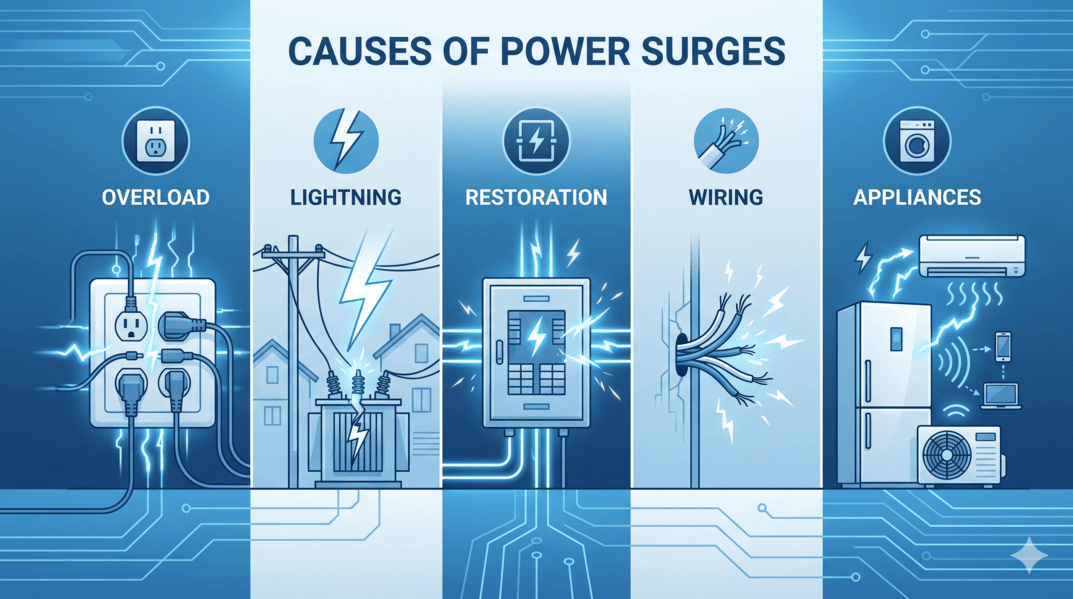
Surges come from several directions simultaneously, and Vancouver's specific conditions make each one more relevant than the generic textbook version would suggest.
BC Hydro Grid Events and Outage Restoration
The most common large surge event in Vancouver homes isn't lightning — it's BC Hydro grid activity. When power goes out and comes back on, the restoration doesn't always arrive smoothly. Switching operations, reconnection of large loads on the grid, and the general chaos of getting power back to a neighbourhood after a storm can all produce voltage spikes that travel into your home through the service entrance. This is why unplugging sensitive electronics during an outage is a real recommendation, not just cautious advice.
Lightning
A direct lightning strike on your home's electrical system is comparatively rare, but a nearby strike — on a power line, a tree close to utility lines, or even the ground nearby — can induce a voltage spike that travels into your home's wiring. The Lower Mainland gets thunderstorms. Not as often as, say, Alberta, but enough. And when they come, they come with wind that takes down trees and utility lines.
Your Own Appliances
This one surprises people. High-draw appliances with motors — your air conditioner, refrigerator compressor, washing machine, shop vac — create small internal surges every time they start up or shut off. The motor's magnetic field collapses or engages, and that event briefly disrupts the current on the circuit. If your home's wiring is in good condition and your panel is properly sized, these surges stay small and generally aren't a problem for robust appliances on the same circuit. But on older wiring, with an ungrounded outlet, or on a circuit already running close to its rated capacity, these regular internal events can cause sustained low-level stress that adds up.
Faulty Wiring
Old or damaged wiring — particularly aluminium branch circuit wiring installed in Lower Mainland homes between 1965 and 1976 — resists current inconsistently. Loose connections arc. Arcing creates voltage spikes. Those spikes travel through the circuit to whatever's plugged in. In a pre-1980 home that's never had a wiring assessment, this is happening more regularly than the homeowner typically knows. Our panel and wiring assessment service →
Utility Switching and Equipment Failure
BC Hydro switches loads across the grid throughout the day, particularly during periods of high demand — summer heat waves, cold winter mornings. Each switching event produces a small disturbance on the grid. Usually the utility's equipment handles this cleanly. When it doesn't, or when a transformer or switching station has an equipment fault, the result can be a significant surge event across an entire neighbourhood simultaneously. We've seen that scenario in Burnaby and East Vancouver after summer heat events.
↑ Back to topWhat Does A Power Surge Actually Damage?
The short answer: anything with a microprocessor. Which in a modern home is virtually everything. Let's go room by room, because the scope of this tends to land harder when it's specific.
Kitchen
Your refrigerator has a control board. Your dishwasher has one too. So does your microwave, your induction range if you have one, and any smart appliance connected to your network. The compressor in the fridge is protected to some extent by its own motor windings, but the control electronics are not. A surge that doesn't kill the compressor outright can still take out the control board — and a control board replacement for a mid-range refrigerator runs between $200 and $600 before labour. A new refrigerator is $1,000 to $3,000. Neither is a small number.
Home Office
This is where surge events tend to be most immediately noticeable — and most expensive per item. Laptops, desktop computers, monitors, external drives, and routers all run sensitive electronics at low internal voltages. They are among the first things to fail in a surge event. And unlike a refrigerator, a laptop with a failed motherboard is usually not worth repairing. Expect $800 to $2,500 per machine for replacement, more for professional-grade equipment. External drives that were running during a surge may have lost data in addition to the hardware damage — a cost that doesn't show up in the replacement estimate.
Living Room and Entertainment
Modern televisions are essentially large computers with screens. They're particularly vulnerable because they're often left on standby — plugged in, powered at low level, continuously connected to the circuit. A surge that arrives at 2 AM while you're asleep hits the TV the same as one that arrives while you're watching it. Streaming devices, gaming consoles, audio receivers, and smart speakers round out a living room equipment list that can easily total $3,000 to $8,000 in replacement value.
HVAC
Heat pumps and central air conditioning systems are increasingly common in Metro Vancouver and they're expensive to replace or repair. The control boards in these systems are just as vulnerable as anything else, and because the equipment is often on a dedicated circuit without a point-of-use surge protector, it can take a direct hit from a grid event. A heat pump control board replacement runs $400 to $1,200. A full system replacement, when a surge damages the compressor electronics along with the controls, is $5,000 to $15,000.
Laundry
Washer and dryer control boards. Electronic timers. Variable speed motors. All of these are surge-vulnerable. Modern front-loading washers in particular are almost entirely dependent on their electronics — they won't function without them. Control board replacement: $200 to $500.
| Item | Typical Replacement Cost | Notes |
|---|---|---|
| Laptop / desktop computer | $800 – $2,500+ | Data recovery may add $300–$1,500 |
| Television (55–65") | $700 – $2,500 | Often total loss — repair rarely cost-effective |
| Refrigerator | $1,000 – $3,000 | Control board alone $200–$600 + labour |
| Heat pump / HVAC system | $5,000 – $15,000 | Control board alone $400–$1,200 |
| Washer / dryer | $800 – $1,800 | Control boards $200–$500 + labour |
| Gaming console | $600 – $800 | Often not repairable after surge event |
The Hidden Damage Nobody Talks About
The scenario most people picture when they think about power surge damage is the dramatic kind — one big event, everything that was working stops working, obvious immediate damage. That does happen. But there's a quieter version that causes more cumulative damage across more Vancouver homes, and most homeowners have no idea it's happening to them.
We call it electronic rust, though that's not a technical term — it's just what the degradation looks like at the component level. Small, repetitive voltage spikes from your own appliances cycling on and off, combined with the minor grid fluctuations that happen dozens of times a day in any urban environment, create a sustained low-level stress on every microprocessor in your home. Not enough to trip anything. Not enough to cause immediate failure. Just enough to accelerate the ageing of capacitors and circuit boards at a rate faster than the manufacturer's expected service life.
Your fridge isn't dying. It's being slowly nibbled to death.
The practical effect: a refrigerator that should last 15 years starts having control board issues at year eight. A television that should have a decade of reliable service starts exhibiting display problems at year five. A washer that should run without issues for twelve years needs a control board replacement at year six. None of these failures are obviously connected to anything — no single dramatic event, no clear cause. The appliance just "started acting up."
Here's what most people miss about this: a whole-home surge protector at the panel dramatically reduces the amplitude of these repetitive small events before they reach your circuits. It doesn't eliminate all voltage variation — nothing does — but it clips the peaks consistently enough to make a measurable difference in the longevity of sensitive electronics throughout the home. It's the electrical equivalent of not running your car's engine at redline constantly. The car still works. It just lasts longer.
We've talked to homeowners whose appliances have failed prematurely multiple times and who have never connected those failures to the state of their electrical system. The connection is not obvious. But after the third refrigerator in ten years, it's worth asking whether the fridge manufacturers are all cutting corners at exactly the same time — or whether something in the house is the common factor.
How To Protect Your Home From Power Surges
There's a layered approach to surge protection that actually works, and it's important to understand what each layer does and doesn't cover.
Point-of-Use Surge Protectors — Not the Cheap Ones
The power bar from the checkout lane at the hardware store for $8 is not surge protection. It's a power bar. Look for a joule rating on the box — this tells you how much energy the protector can absorb before it stops protecting. For computers, televisions, and audio equipment, look for 2,000 joules minimum. For home theatre systems or professional equipment, 3,000 joules and above. Replace any point-of-use protector that has taken a significant hit — they don't regenerate, and an exhausted protector provides no protection at all even if it still appears to work.
Whole-Home Surge Protection — What It Actually Is
A whole-home surge protector is a device installed at your main electrical panel that intercepts large voltage spikes before they can travel through your home's wiring to individual circuits. Unlike a point-of-use strip, it protects everything simultaneously — your HVAC system on its dedicated circuit, hardwired appliances, anything that isn't on a surge-protected strip, and frankly, anything you've forgotten about. It doesn't replace point-of-use protection for sensitive equipment, but it provides the first and most important line of defence against grid events and large external surges.
Installation by a licensed electrician typically runs a few hundred dollars. Which is less than replacing a single laptop. Our whole-home surge protection service →
Proper Grounding and Panel Health
A surge protector — whole-home or point-of-use — redirects excess voltage to ground. If your home isn't properly grounded, there's nowhere for it to go. The protection doesn't work as intended. This is why grounding and panel condition matter as much as the protection devices themselves. Ungrounded outlets, panels that are aged or overstuffed, and aluminium branch circuit wiring in older homes all affect how well your surge protection actually performs under a real event. Panel assessment and upgrade →
What To Do During a BC Hydro Outage
Unplug sensitive electronics and high-value appliances if you can do so safely. Don't assume a point-of-use protector will handle the restoration surge — they help, but whole-home protection is significantly more effective at clipping what arrives at the service entrance. Monitor the BC Hydro outage map on your phone. When power is restored, let it stabilise for a few minutes before reconnecting everything — and reconnect one major appliance at a time rather than all at once.
We install panel-level surge protection across Metro Vancouver. One visit, done properly, protects everything.
Benefits of Surge Protection
Fire Prevention
Voltage spikes create heat. Heat in wiring, inside appliances, and at loose connections can start fires. The connection between poor electrical protection and residential fires is direct — and in Vancouver's older housing stock, with aged wiring and panels that haven't been assessed in years, the risk is higher than most homeowners appreciate.
"Electrical fires claim the lives of approximately 485 Americans annually and injure 2,305 more."
— National Fire Protection Association, Electrical Fire Research
Canada's numbers are proportionally similar. The NFPA data consistently shows that electrical distribution equipment — panels, wiring, and connections — is involved in a significant proportion of structural fire incidents. Surge protection that reduces arcing events and voltage stress on wiring is a direct contribution to fire prevention.
Energy Savings and BC Hydro Bills
High-resistance connections caused by loose wiring and ageing components don't just create surge risk — they waste energy. A circuit with elevated resistance draws more current than it should to deliver the same output. That extra current shows up on your BC Hydro bill as unexplained consumption. Addressing wiring health as part of a broader electrical assessment typically produces modest but real reductions in energy use. BC Hydro's energy efficiency resources are worth a look if your bills have been climbing without obvious explanation.
Lower Repair and Replacement Costs
We've said this to a hundred homeowners — the cost of prevention is almost always a fraction of the cost of repair. Whole-home surge protection installed today costs a few hundred dollars. Replacing the appliances and electronics that a single grid event can take out costs thousands. The math is not subtle.
Insurance and Technical Safety BC Compliance
Some commercial property insurers require periodic electrical assessments and documentation of surge protection as part of their policy conditions. Residential insurers increasingly factor electrical system condition into their underwriting. Technical Safety BC requires all electrical work to be permitted and inspected — which means any surge protection installation done by a non-licensed person is both uninsured and non-compliant. Having a licensed electrician do the work creates a documented, inspected, code-compliant installation that holds up in an insurance claim. Our thermal imaging inspection service is also relevant here — it identifies high-resistance connections and fault conditions before they become claim events.
↑ Back to top"Electrical equipment shall be installed in a neat and workmanlike manner."
— Canadian Standards Association (CSA), C22.1 Canadian Electrical Code
Is Your Vancouver Home At Higher Risk?
Some Vancouver homes are more exposed to surge damage than others — not because of the neighbourhood, but because of the age and condition of their electrical systems.
Pre-1980 Homes
If your home was built before 1980, there's a real chance the electrical system has never been upgraded. The panel may be a 100-amp service in a home that now runs induction cooking, EV charging, and central air. Aluminium branch circuit wiring — installed extensively in the Lower Mainland between 1965 and 1976 — becomes a surge risk factor when connections loosen over time. Ungrounded outlets, common in older homes throughout East Van, Kitsilano, Mount Pleasant, and the West End, mean surge protection devices can't do their job properly even when installed. Our electrical inspection service →
Ungrounded Outlets
We find ungrounded three-slot outlets in roughly half the older Vancouver homes we inspect. A surge protector plugged into an ungrounded outlet provides limited protection — the device has nowhere to redirect the excess voltage. If your home has ungrounded outlets, addressing them isn't optional context for surge protection. It's the prerequisite.
Older Panels
Certain panel brands installed in BC homes in the 1960s through 1980s have documented failure issues — breakers that don't trip when they should, connections that arc internally, and bus bars that have degraded past their safe service life. These panels are a surge risk independent of external events, because they can generate surge conditions internally. If your panel is more than 30 years old and hasn't been assessed, it's worth knowing what you have. Panel assessment and upgrade →
Renters vs. Homeowners — Who Is Responsible?
Short answer: the building's electrical infrastructure is the landlord's responsibility; the electronics and appliances inside the suite are generally the tenant's. If you're renting in an older Vancouver building and you own expensive electronics, point-of-use surge protection for your equipment is something you can install yourself. Whole-home surge protection at the panel requires a licensed electrician and the landlord's involvement. We've done this work for both homeowners and property managers — it's not complicated, and most landlords respond well when the cost and liability arguments are laid out clearly.
Kato's team offers electrical inspections across Metro Vancouver. We'll assess your panel, grounding, and surge protection status and give you a straight answer on your risk level. Don't wait for the next surge — Call (604) 239-3084 or book an inspection online →
Related services:
We serve all of Greater Vancouver:
Questions we hear regularly from Vancouver homeowners — answered directly.
Here's the honest version: in twenty-odd years of working in Vancouver homes, we've seen surge damage ruin refrigerators, destroy home offices, and take out HVAC systems that were installed the previous year. We've also seen homeowners who spent $400 on whole-home surge protection ten years ago and have replaced nothing. The protection works. The surges are real. And the next BC Hydro outage isn't something that might happen eventually — the Lower Mainland gets storms, the grid has events, and restoration surges are a normal part of life here. The question is whether your home is ready when it does.
We're not in the business of making people anxious. But we are in the business of telling you the truth about what we see, and what we see regularly are homes that weren't protected when they should have been. Most of those calls come after something expensive died. Yours doesn't have to.
One call to Kato Electrical could save you thousands in damaged appliances and repairs. We serve Vancouver and the entire Lower Mainland.