
Knob-and-Tube Wiring in Metro Vancouver: Which Neighbourhoods Still Have It
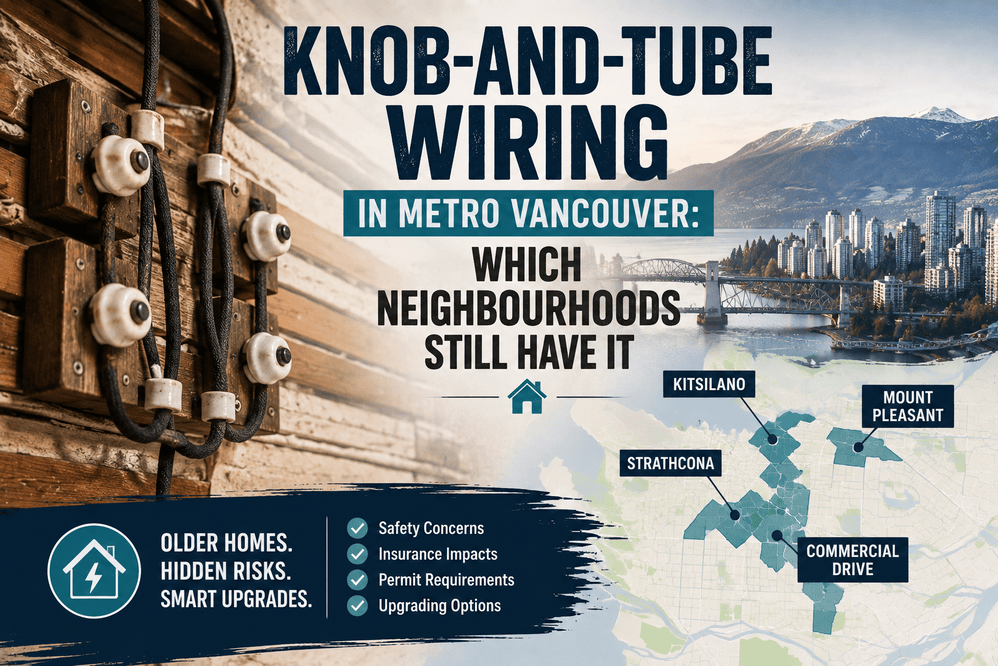
You're eight days into a subject-removal period on a 1936 house off Commercial Drive. The home inspector's report says "older wiring observed in attic, recommend evaluation by a qualified electrician." Your broker mentions, almost in passing, that the insurer wants to know what kind of wiring it is before they'll confirm the quote.
That sentence in the inspection report is doing a lot of work. It might mean cloth-covered wiring that was replaced in 1978 and is perfectly fine. Or it might mean live knob-and-tube running through three of four exterior walls, buried under blown-in insulation someone added in 2009.
Those are very different situations, and you've got eight days.
So here's where knob-and-tube actually turns up across Metro Vancouver, how to recognise it, and what genuinely matters once you find it.
The short answer
Knob-and-tube wiring is common in Metro Vancouver homes built before 1950. In Vancouver that means Strathcona, Grandview-Woodland, Mount Pleasant, Kitsilano, the West End, Hastings-Sunrise, Kerrisdale, Dunbar and Point Grey. Beyond the city: North Burnaby and Capitol Hill, Queen's Park and Sapperton in New Westminster, Lower Lonsdale, Ambleside and Hollyburn, and Steveston. It is not inherently dangerous — the risk comes from amateur modifications made over the decades, brittle insulation near heat, and blown-in insulation burying wiring that was designed to shed heat into open air.
What knob-and-tube actually is
Two separate conductors — one hot, one neutral — run parallel through the structure, held clear of the framing by white ceramic knobs and passed through joists and studs inside ceramic tubes. The wire is copper, insulated with rubber and wrapped in cloth.
The design is deliberate and, for its era, sound. Separating the conductors reduces short-circuit risk. Keeping them away from wood and suspended in open air lets heat dissipate. It was competent engineering for the loads of the 1920s.
Two things it doesn't have: a ground conductor, and any expectation of modern electrical demand. Grounding became standard between roughly 1950 and 1960 — which is why that decade is the practical dividing line.
Metro Vancouver Home Wiring by Era
What's likely behind the walls, by build date
Knob-and-tube likely
Ceramic knobs and tubes, cloth-covered wire, no ground conductor
Transitional
Ground conductors became standard. Could be either — worth checking
Aluminum branch wiring
Common in Vancouver Specials. Different issue, different fix
If your home falls in that 1965–75 band, knob-and-tube isn't your concern but aluminum branch circuit wiring might be. Different problem, different remedy, similar insurance conversation.
↑ Back to topThe neighbourhood map
This is where the housing stock is old enough for knob-and-tube to be plausible. It is not a claim that any particular house has it — plenty were rewired decades ago. Read it as where to check, not what's there.
↔ Swipe the table sideways to see all columns.
| Area | Neighbourhoods | Main build era |
|---|---|---|
| Vancouver — East | Strathcona, Grandview-Woodland (Commercial Drive), Mount Pleasant, Hastings-Sunrise, Riley Park | 1890s–1940s |
| Vancouver — West | Kitsilano, Point Grey, Dunbar-Southlands, Kerrisdale, Shaughnessy, West End, Marpole | 1910s–1940s |
| Burnaby | North Burnaby, Capitol Hill, The Heights | 1920s–1940s |
| New Westminster | Queen's Park, Sapperton, Brow of the Hill, West End | 1890s–1940s |
| North Vancouver | Lower Lonsdale, Grand Boulevard, Central Lonsdale | 1900s–1940s |
| West Vancouver | Ambleside, Dundarave, Hollyburn | 1920s–1940s |
| Richmond | Steveston | 1900s–1940s |
| Port Moody | Moody Centre | 1910s–1940s |
| Maple Ridge | Port Haney | 1900s–1940s |
Newer suburbs — most of Surrey, Coquitlam, Port Coquitlam and Delta — developed largely after the knob-and-tube era. Aluminum branch wiring from the 1965–75 period is the more likely concern in those areas.
Strathcona and Queen's Park are the two that come up most, and for the same reason: they're among the oldest residential areas in the region, and a lot of the housing has been renovated cosmetically without anyone touching the wiring. A beautiful kitchen and original knob-and-tube in the same house isn't unusual. It's close to a pattern.
How to tell if your house has it
You can do a first pass yourself, and it's worth doing before you pay anyone. Look in the places where original wiring was never covered up.
Four Things to Look For
⚪ White ceramic knobs
Small porcelain insulators nailed to joists and studs, holding wire clear of the wood.
🔘 Ceramic tubes
Where wire passes through a joist or stud, it runs inside a ceramic sleeve rather than a drilled hole.
➰ Two separate wires
Hot and neutral run apart from each other, cloth-covered — not bundled in one modern sheathed cable.
🔌 Two-prong outlets
Ungrounded receptacles throughout, often alongside a 60-amp service and a fuse panel.
Where to look: the attic first — it's where knob-and-tube most often survives untouched. Then the basement ceiling and any crawl space. Anywhere the framing is exposed.
What you can't determine yourself: whether the wiring is still live, how much of it remains behind finished walls, or what condition the insulation is in. A visual from the attic tells you the house has knob-and-tube. It doesn't tell you how much, or whether it matters.
A home inspector can observe and note. A licensed electrician can assess, test and document. Those aren't the same thing, and insurers know the difference — which is why "older wiring observed" in an inspection report creates an obligation rather than satisfying one. Our electrical inspection service produces the report insurers actually ask for.
The insulation problem
This is the one that matters most, and it's the one almost nobody knows about.
Knob-and-tube was designed to run through open air. The ceramic knobs exist specifically to hold the conductors away from the framing so heat can dissipate. That's not incidental to the design — it is the design.
Now consider what happened across Metro Vancouver from the 1970s onward: homeowners insulated their attics. Blown-in cellulose or fibreglass, poured over the joists, burying whatever wiring was up there.
Wiring that was engineered to shed heat into open air is now packed in insulation. It runs hotter. The rubber insulation degrades faster. And nobody can see it happening, because it's under a foot of cellulose.
Blown-in attic insulation over active knob-and-tube wiring is the single condition we'd want assessed soonest in an older Metro Vancouver home. Not because it's guaranteed to be a problem, but because it's the combination where a problem develops invisibly.
If your home is pre-1950 and the attic has been insulated at some point, that's worth a look. Call Kato Electrical: 604-239-5752
An added complication for anyone planning an energy retrofit: adding insulation to an attic with active knob-and-tube generally means dealing with the wiring first. The rebate-funded insulation upgrade turns into an electrical project. Better to know that at the quoting stage than halfway through.
↑ Back to topActive vs abandoned
An important distinction that changes the whole conversation, and one people rarely ask about.
Active knob-and-tube is still energised and still serving circuits in the house. Abandoned knob-and-tube was disconnected when the home was partially or fully rewired, but the old wire was left in place because pulling it out of finished walls wasn't worth the cost.
Abandoned knob-and-tube looks alarming in an attic and means very little. Active knob-and-tube is the thing insurers ask about.
You can't tell them apart by looking. It takes testing. Which is why a house that appears to be full of knob-and-tube sometimes turns out to have three live circuits, and why an assessment can occasionally be very good news.
↑ Back to topInsurance, mortgages and buying
Briefly, because we've covered this properly elsewhere.
Many BC insurers won't cover a home with active knob-and-tube, and others impose conditions such as an electrician's certification or replacement within a set period. Since lenders require the property to be insured, no insurance can effectively mean no mortgage — the constraint arrives through insurability rather than through the lender directly.
If you're buying: confirm insurability with a broker during your subject-removal period, the same way you confirm financing. Not after.
For what insurers require, how certification works, and what the options look like when a policy is at stake, see our full guide: Knob and Tube Wiring: Insurance, Risks, and Upgrades.
On a subject-removal clock? We can usually get out to assess an older Metro Vancouver home quickly, and the report is what your insurer or broker actually needs. Call 604-239-5752 or request a quote.
Your options
Three routes, and the right one depends on how much active knob-and-tube there is, what your insurer requires, and what you're planning to do with the house.
Full rewire
Every circuit replaced with modern grounded cable. The complete answer, and the one insurers are happiest with. Cost is driven mainly by access — an open-wall renovation is a different project from fishing every run through finished plaster.
Staged replacement
Priority circuits first: kitchen, bathrooms, laundry, anything buried under insulation, anything showing brittle insulation or amateur splices. The rest follows later. Legitimate and common — but check whether your insurer accepts it before scoping.
Assess and maintain
Where the system is genuinely sound, undisturbed and not buried, and where your insurer is satisfied with certification. Requires a documented electrical inspection, and it's a decision to revisit rather than settle.
Whichever route, the sequence is the same: find out how much is active, find out what your insurer requires, then scope the work. Doing it the other way round is how people end up paying for a full rewire they didn't need — or discovering mid-project that a partial one won't satisfy the policy.
All electrical work in BC requires a permit and a licensed contractor. Depending on your municipality that permit comes from Technical Safety BC or from the city itself — our city-by-city permit guide covers which is which.
Kato Electrical inspects and rewires older homes across Metro Vancouver. We'll tell you how much active knob-and-tube is there, what condition it's in, and what your realistic options are — with the documentation your insurer needs. Licensed, insured, permitted.
Sources & further reading
What Metro Vancouver homeowners and buyers ask us about knob-and-tube wiring.
Anywhere with substantial pre-1950 housing. In Vancouver: Strathcona, Grandview-Woodland, Mount Pleasant, Kitsilano, the West End, Hastings-Sunrise, Kerrisdale, Dunbar-Southlands, Point Grey, Shaughnessy, Riley Park and Marpole.
Beyond the city: North Burnaby, Capitol Hill and The Heights; Queen's Park, Sapperton and Brow of the Hill in New Westminster; Lower Lonsdale and Grand Boulevard; Ambleside, Dundarave and Hollyburn; Steveston; Moody Centre; Port Haney. This shows where the housing is old enough for it to be plausible — not that a given house still has it. Many were rewired decades ago.
There's no single cut-off, but 1950 is the practical line for Metro Vancouver. Knob-and-tube was standard before then, and a ground conductor became standard between roughly 1950 and 1960.
A 1930s home is a strong candidate. A 1965 home isn't — though it may have aluminum branch wiring instead. Homes from the transitional 1950s could have either, which is why an inspection beats a guess.
Look in unfinished spaces — attic first, then basement ceiling and crawl space. You're looking for white ceramic knobs holding wire clear of the framing, ceramic tubes where wire passes through joists, and two separate cloth-covered conductors running parallel rather than one sheathed cable. Two-prong ungrounded outlets throughout and a 60-amp service are supporting indicators.
What you can't establish yourself: whether it's still live, how much remains behind finished walls, or what condition the insulation is in. That needs a licensed electrician.
Not inherently. Original installations were competently done to the standards of their era, and undisturbed systems in good condition have given decades of service.
The risk comes from what happened afterwards: amateur splices and extensions added over the years, rubber insulation going brittle near heat sources, no ground conductor in kitchens and bathrooms, and — most significantly — blown-in insulation burying wiring that was designed to dissipate heat into open air.
Usually — but the chain runs through insurance. Lenders require the property to be insured, and many BC insurers won't cover active knob-and-tube, or attach conditions like replacement within a set period. So the real constraint is insurability, not the mortgage.
If you're buying a pre-1950 home, confirm insurability with a broker during subject removal, the same way you confirm financing. Finding out afterwards leaves you with far fewer options. More detail in our knob-and-tube insurance guide.
Not by regulation. The BC Building Code permits existing knob-and-tube to remain where it's undisturbed, and no law requires a homeowner to remove it.
Renovation changes that — any electrical alteration or addition must meet current standards, so work touching the system generally means replacing that portion. In practice, the pressure comes from insurers and buyers rather than the code. Either way, the work requires a permit and a licensed contractor.
No. Staged replacement is legitimate and common. Priority normally goes to kitchens, bathrooms and laundry circuits where the missing ground matters most, to anything buried under insulation, and to any section with brittle insulation or amateur splices.
Whether staged work satisfies your insurer depends on the insurer — confirm before scoping. An electrical inspection establishes how much active knob-and-tube is actually there, which is what the decision hinges on. Knob-and-tube rewiring →
Knob-and-tube has a worse reputation than it deserves and a bigger problem than most people realise. It isn't a fire waiting to happen. It also isn't something to leave buried under attic insulation for another decade on the assumption that it's been fine so far.
If your house is pre-1950 and nobody has looked, the useful thing is knowing what's actually up there. That's a morning's work for an electrician and it settles the question either way.
Kato Electrical works across Metro Vancouver: