
Electrical Grounding in Household Wiring

Most homes that have had ungrounded wiring for years have no obvious symptoms — right up until something fails. Don't wait for a short circuit to find out. Call Kato Electrical: (604) 239-3084 — grounding assessments are free.
Electrical Grounding: What It Is, How It Works, and Why Your Vancouver Home Needs It
Electrical grounding is one of those things that works silently in the background of every safe home — so quietly that most people have never thought about it once. It only becomes visible when it is absent, and even then it tends to stay hidden until the moment a fault in the wiring sends current somewhere it was never meant to go.
Understanding what electrical grounding is, whether your home has it, and what to do if it is missing or incomplete is useful knowledge for every homeowner — particularly in Vancouver, where a significant portion of the housing stock includes older homes built before modern grounding requirements became standard.
"The purpose of grounding is to protect people from shock hazards by preventing voltage from appearing on exposed metal parts of equipment, and to provide a low-impedance path for fault current so that overcurrent protective devices will operate."
— NFPA 70: National Electrical Code, Article 250What Is Electrical Grounding?
Electrical grounding creates a deliberate, physical connection between your home's electrical system and the earth — providing a safe, low-resistance path for fault current to travel if something goes wrong. Think of it as an emergency exit for electricity that has lost its way. (Electricity, like most things that have somewhere to go, will take the path of least resistance. Grounding just makes sure that path is not through you.)
In a normal electrical circuit, current flows into your home through the live wire, does its work powering an appliance, and returns to the panel through the neutral wire. This cycle is continuous and, when the system is intact, self-contained. The problem arises when the neutral wire breaks, loosens, or develops a fault — at which point the current needs somewhere else to go. Without a grounding system, it finds that somewhere else on its own, which might be the metal casing of your fridge, a water pipe running through the wall, or anyone who happens to touch either.
Grounding prevents this by providing the electricity with a dedicated alternative route — one that leads safely into the earth, where it dissipates harmlessly rather than damaging equipment or injuring people.
↑ Back to topHow Electrical Grounding Works
Every properly wired modern home should contain three types of wire serving three distinct functions:
Live Wire (Black)
Carries current from the panel to appliances and outlets. This is the wire that brings power to where it is needed. High voltage — do not touch.
Neutral Wire (White)
Returns current to the panel and ultimately to the ground, completing the circuit. Under normal conditions this wire carries return current safely back.
Ground Wire (Green / Bare)
The safety path. Stays at zero voltage under normal conditions. Activates only if there is a fault, routing excess current safely to the grounding rod buried in the earth.
The grounding wire system connects to every appliance, device, and electrical box in the house, all leading back to the main service panel where they connect to a grounding bar. From the grounding bar, a wire runs to a copper grounding rod buried in the earth near the foundation. The earth itself is the final destination — it absorbs the fault current without consequence.
In older Vancouver homes — particularly those built before 1960 — grounding was either done using metal conduit as the ground path (which can degrade over decades) or was not done at all. Two-prong outlets throughout the house are a reliable indicator that grounding was not installed. If your home was built before 1960 and has never had its wiring upgraded, an assessment is worth scheduling before something else prompts it. Call us: (604) 239-3084 | Our electrical inspection service →
How to Test Whether Your Home Is Grounded
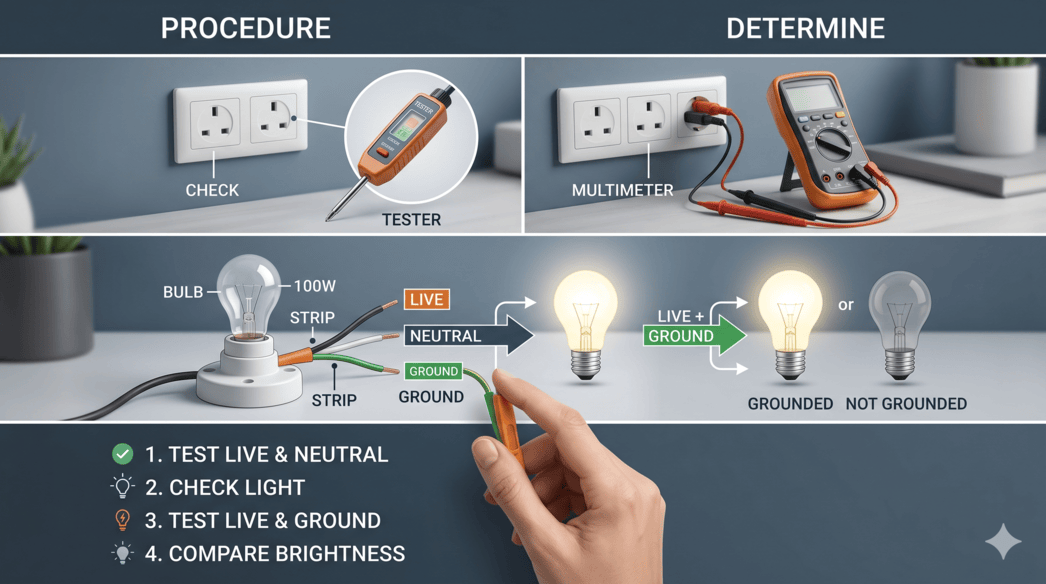
Three-port outlets around your home are a reasonable starting indicator — they were designed with grounding in mind. However, the presence of three-port outlets does not guarantee the grounding wire was actually connected behind them. Some installations were wired with three-port outlets for appearance without completing the grounding connection. The only way to know is to test.
Testing with a Circuit Tester
-
1
Insert the red probe into the smaller slot (the live slot) and the black probe into the larger slot (the neutral slot). If the indicator light comes on, the live-to-neutral connection is working.
-
2
Now move the red probe to the top round hole (the ground port) while keeping the black probe in the neutral slot. If the indicator lights with the same brightness — the outlet is properly grounded.
-
3
If the light does not come on, or is noticeably dimmer in the ground position, the outlet is either poorly grounded or not grounded at all. Repeat for all outlets — grounding can be inconsistent between rooms and circuits.
A 100W bulb in a base socket with stripped wire ends can substitute for a circuit tester in a pinch. First confirm the live-to-neutral connection (bulb on = working circuit). Then move one wire to the ground port: if the bulb shines at the same brightness, the ground is functioning. Dimness or no light indicates a grounding problem. For a definitive, whole-house grounding assessment, call a licensed electrician. (604) 239-3084
Why Electrical Grounding Matters
-
Overload protection
During a power surge, voltage spikes and excess current enters the wiring — generating heat. A grounding system gives that excess current a direct path to the earth, where it dissipates safely. Without grounding, the excess current has nowhere to go except through your wiring insulation, appliance components, and whatever else is conducting. -
Faster, more stable power transmission
A grounded system provides a seamless, complete path for electricity. Current reaches outlets consistently and without resistance drop. This is why appliances in properly grounded homes tend to start and run more reliably than in homes with aging, ungrounded wiring. -
Voltage stabilization
The standard residential voltage in Canada is 120 volts. Voltage fluctuations above or below this rating stress and damage appliances. Grounding helps the system maintain voltage equilibrium by providing a reference point — literally connected to the ground, which is at zero volts — against which all voltages in the system are measured and regulated. -
Protection against electrocution
That slight jolt you sometimes feel when touching a metal appliance? That is leakage current finding a path through you to the ground — exactly what grounding is designed to prevent. A properly grounded system routes that current away from surfaces people can touch, back through the dedicated ground wire and into the earth. Technical Safety BC requires grounding in all residential properties under BC Electrical Code. -
Fire prevention
Ungrounded wiring allows fault current to run through whatever conducting material is available — insulation, wood framing, anything in its path. This generates heat that can ignite surrounding material. Grounding eliminates this by providing a dedicated low-resistance path that does not run through flammable building materials. Related: Smoke & CO detector installation → -
Appliance longevity and repair cost savings
Power surges and excess current that has nowhere to go eventually destroy the components they pass through. A grounded electrical system significantly extends the operational life of appliances by ensuring they are never subjected to voltage above their design parameters. The cost of grounding a home is a fraction of the cost of repeatedly replacing appliances damaged by an ungrounded system.
How to Choose Electrically Grounded Appliances

Appliance grounding and household wiring grounding work together. An appliance with a three-pronged plug connects its own metal casing to the grounding system through the third prong — ensuring that if the appliance develops an internal fault, the fault current goes through the ground wire rather than through the casing and into anyone touching it.
Most modern appliances come with three-pronged plugs as standard. When buying any electrical appliance, confirm it has a three-pronged plug. If your home only has two-port outlets, the options are:
Do not remove the ground prong from a three-pronged plug to make it fit a two-port outlet. The ground prong is not optional — it is what keeps the appliance's metal casing at zero volts. Remove it and you remove the safety connection between the appliance and the grounding system. A faulted appliance without a connected ground prong becomes energized metal. This is how electrocutions happen.
✓ Use a properly grounded extension cord with three-port sockets and plug that into the two-port outlet
✓ Use a plug adapter — but only if it has the pigtail wire or metal loop correctly connected to a grounded metal box
✓ The best solution: have three-port, properly grounded outlets installed throughout your home by a licensed electrician
Our electrical renovation services → | Call us: (604) 239-3084
Other Electrical Protection Measures in Household Wiring

Grounding is the foundation of electrical safety in your home, but it works alongside other protective devices. Each one addresses a different aspect of electrical hazard:
Circuit Breakers
Installed in your main service panel, circuit breakers monitor current on each circuit and trip instantly when they detect an overload or short circuit. They protect wiring from overheating and prevent fires from sustained electrical faults. Larger appliances — refrigerators, ovens, washing machines — typically have dedicated breakers. Our circuit breaker services →
GFCI Outlets
Ground Fault Circuit Interrupter outlets monitor the balance between outgoing and returning current. If they detect a ground fault — current taking an unintended path, such as through a person — they trip almost instantly. Required by BC Electrical Code in bathrooms, kitchens, garages, and outdoor areas. A practical interim protection measure in homes without full grounding.
Pipe Bonding
Metal water piping inside walls can carry fault current if the wiring develops a fault near the pipes. Electricians bond metal piping to the grounding system — connecting a grounding wire to the water pipe near the heater or where pipes enter the home. This prevents the piping from becoming energized and electrocuting anyone who touches a tap or fitting.
Surge Protection
Whole-home surge protectors install at the main panel and absorb voltage spikes before they can reach sensitive appliances and electronics. Particularly valuable in areas with frequent storms or utility switching events. Works best when combined with a properly grounded electrical system — surge protectors need a solid ground path to function effectively. Panel upgrade service →
How Much Does Electrical Grounding Cost in Vancouver?
Cost depends almost entirely on the current state of your wiring. Here is a practical breakdown:
| Scenario | Typical Cost Range | Notes |
|---|---|---|
| No grounding wire present anywhere in the system | $5,000+ | Major project — running new ground wires throughout the home, installing grounding rod and bar. Cost varies significantly with home size and access. |
| Grounding wire installed during construction but not connected to devices | Under $1,000 | Wire is in the walls but was never terminated. Connecting it is significantly less disruptive. |
| System is grounded but only two-port outlets are installed | $150–$200 per outlet | Replacing two-port outlets with three-port outlets where grounding wire is present. |
| Some three-port outlets improperly grounded | $150–$200 per outlet | Applies when main panel is grounded but individual outlet connections were not made correctly. |
| Replacing standard outlets with GFCI outlets | $150–$200 per outlet | Provides protection at the outlet level in locations where full grounding is not yet in place. |
The cost of grounding your home before something fails is a fraction of the cost of replacing appliances damaged by a power surge, repairing fire damage, or dealing with an electrical injury. Most homeowners who call us about grounding have either just received a report from a home inspector, experienced a noticeable surge, or are renovating. All three are good reasons to act. Call us: (604) 239-3084 — grounding assessments are free.
Related services from our team:
Related reading: 10 Overlooked Electrical Mistakes Homeowners Make | 5 Common Electrical Problems at Home | 5 Warning Signs Your Breaker Box Needs Repair
↑ Back to topIs Your Vancouver Home Properly Grounded? Find Out Before Something Forces the Issue.
Our licensed electricians assess grounding condition, install grounding systems, and upgrade outlets across the Lower Mainland. Upfront pricing, permits handled, work guaranteed.
Serving All of Greater Vancouver
Common questions about electrical grounding — answered by our licensed Vancouver electricians.