
Efficient Heating Solutions for Vancouver Homes: The Role of Electrical Heat Pumps and Smart Thermostats

Heating installations book up quickly before Vancouver's wet season. Current CleanBC and BC Hydro rebates are among the most generous available — and they won't stay this way indefinitely. Call Kato Electrical: (604) 239-3084
All You Need to Know About Electrical Heating Solutions
A homeowner in North Burnaby bought a 1968 bungalow last spring. No ductwork anywhere in the house. Original baseboard heaters in every room — the ones the previous owner had apparently been running on optimism and extra blankets. On the first cold morning of October, the new owner stood in front of their electrical panel trying to work out if the service could handle a heat pump AND still run the microwave at the same time. The answer, it turned out, was: not without a panel assessment first. And their panel — a 100-amp service already operating near capacity — needed looking at before anything else.
This is not an unusual scenario. It is Metro Vancouver's most common one. The housing stock, the electrical infrastructure, and the heating options have all changed at very different rates over the past several decades. The gap between what most older Vancouver homes have and what is now available is significant — and so is the gap between what most homeowners know and what is actually worth knowing.
Vancouver's heating options have changed significantly in the last decade. The best system for your home is not always obvious. Here's how to actually figure it out.
Vancouver Electrical Heating Services — Making the Right Choice

The right electrical heating solution for a Vancouver home depends on four things: what the home already has, what the electrical panel can support, what the homeowner is trying to achieve, and what the budget allows. In Metro Vancouver specifically, older homes without ductwork narrow the realistic options to ductless solutions — mini-split heat pumps, baseboard heaters, in-floor radiant, or some combination. The current CleanBC and BC Hydro rebate landscape makes heat pump installation more financially accessible than it has ever been. But the right answer still depends on the specific home.
We help Vancouver homeowners choose and install electric heating solutions every week. The right answer depends on the home — and we've seen enough Vancouver homes to know what actually works and what doesn't in this climate and this housing stock.
A 1960s East Van duplex with original baseboard heaters and a 100-amp panel is a genuinely different situation from a 1990s North Shore home where someone is thinking about replacing a gas furnace. Different starting points, different budgets, different right answers. The sections below walk through each system — what it is, where it works, and when Kato recommends it.
↑ Back to topElectric Heating Systems — An Overview
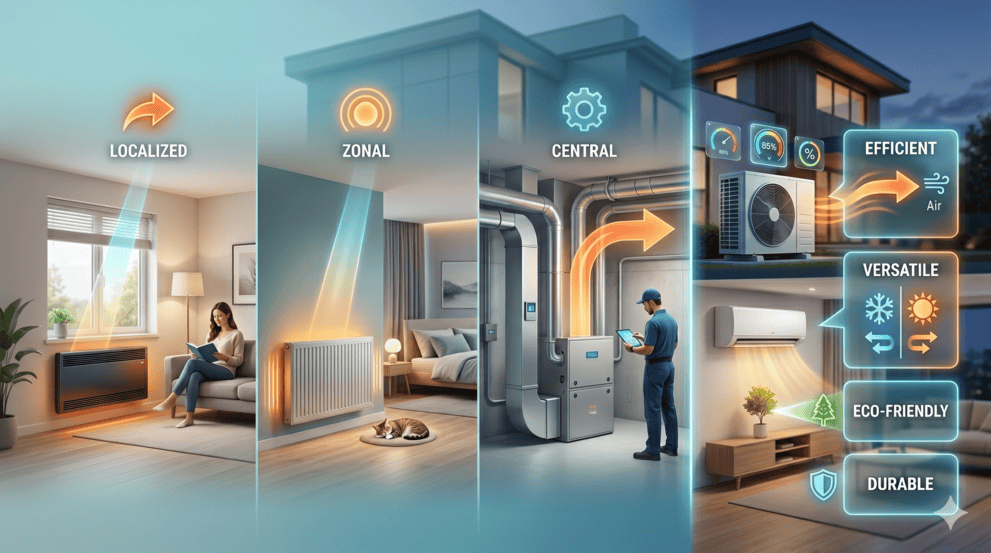
Electric heating splits into two fundamentally different categories, and understanding the distinction is the most useful thing this article can tell you.
Resistance heating — baseboard heaters, in-floor radiant cables, infrared heaters, electric furnaces — converts electricity directly to heat. One unit of electricity in, one unit of heat out. This is 100% efficient in the physics sense. But there's no multiplication effect: you pay full electricity rates for every unit of heat you get.
Heat pump technology works entirely differently. A heat pump doesn't generate heat — it moves it. In heating mode, it extracts warmth from outdoor air and concentrates it indoors. The electricity powers the compressor and fans that do the moving; it doesn't create the heat itself. The result is a COP — coefficient of performance — typically between 3 and 4 in Vancouver's climate. Three to four units of heat energy for every one unit of electricity consumed.
Vancouver's mild winters make heat pumps more efficient here than almost anywhere else in Canada. Modern cold-climate heat pumps are rated to operate effectively down to −25°C — temperatures Metro Vancouver essentially never sees. The efficiency advantage that disappears in extreme cold never actually disappears here.
Here's what most Vancouver homeowners who've been running resistance heating for years don't realise: there was a better option available. They just weren't aware of it, the upfront cost felt prohibitive, or the rebates didn't exist yet. All three of those things have changed.
↑ Back to topElectric Baseboard Heaters
Electric Baseboard Heaters
Baseboard heaters use electric resistance coils to heat air, which rises by convection and circulates through the room. Each unit operates independently — true zone control, heat only what you need. For older homes, suites, and individual rooms where a more sophisticated system isn't in the current budget, baseboard heaters remain practical and reliable.
The baseboard heater that's been on the wall since 1974 will still heat your room. It will also heat your room in roughly the same way a large hairdryer would — at roughly hairdryer efficiency. The technology has moved on. Modern baseboard heaters are meaningfully more efficient than 1970s units, and replacing old heaters produces a noticeable improvement before anything else changes.
Before replacing the heaters themselves, the first upgrade for any home still on original baseboard heating is programmable thermostats. A thermostat that drops temperature when a room is empty and comes back up before you need it changes the economics of baseboard heating without replacing the hardware. Each baseboard heater requires a dedicated 240V circuit — a home with multiple heaters across several rooms accumulates significant panel load. See our dedicated circuit installation guide and the panel capacity section below.
A baseboard heater that smells burning beyond the first-day-of-autumn dust moment, trips a breaker, has visible cracking on the element, or is over 25 years old is due for replacement. Call Kato: (604) 239-3084
Ductless Mini-Split Heat Pumps
Ductless Mini-Split Heat Pumps
This is the system we install most often in Metro Vancouver right now — and for good reason. A ductless mini-split heat pump moves heat rather than generating it. In heating mode, it draws warmth from outdoor air and concentrates it inside. In cooling mode, the process runs in reverse. One system, both functions, no ductwork required.
The efficiency advantage in Vancouver's climate is real and consistent. A COP of 3 to 4 in our climate zone is realistic year-round — not just when temperatures are mild. The efficiency gap versus baseboard heating is significant, and it shows up clearly on a BC Hydro bill across a heating season. The cooling capability matters more than it did five years ago: Vancouver summers have been getting warmer, and a system that heats in winter and cools in summer from a single installation is a different value proposition than it was a decade ago.
Installation requirements: a dedicated 240V circuit (typically 30 to 60 amp depending on system size), panel capacity confirmed before installation, outdoor unit placement with adequate clearance, and refrigerant line routing from outdoor compressor to indoor air handler(s). Panel assessment is part of every heat pump installation we do →
"Heat pumps can provide up to three times more heat energy than the electrical energy they consume."
— BC Hydro, Heat Pump Rebate Program
Interested in a heat pump for your Vancouver home? Kato handles the assessment, installation, panel work if needed, and rebate documentation. Call us: (604) 239-3084
In-Floor Radiant Electric Heating
In-Floor Radiant Heating
Electric radiant floor heating installs heating cables or mats beneath flooring — tile, stone, or engineered hardwood — and warms the surface directly. Heat radiates upward evenly through the room. No cold spots, no drafts, no noise. A warm tile floor on a November Vancouver morning is a qualitatively different experience from stepping onto cold tile — and people who've had it installed in their bathrooms consistently describe it as an upgrade they'd never give back.
Where it genuinely makes sense: bathrooms, kitchens, entryways, and any room where flooring is already being replaced in a renovation. It goes under the tile, not on top — which means the renovation window is the correct moment to install it. As supplemental zone comfort heating, operating costs are modest. As a primary whole-home heat source, it's expensive. Most Vancouver homeowners use it for the former.
Electrically: dedicated or shared circuit depending on load, thermostat wiring, and GFCI protection required for bathroom installations. See our electrical outlets article for GFCI requirements in wet locations.
Infrared Heaters
Infrared Heaters
Infrared heaters warm objects and people directly rather than heating the air between them. In a garage with a door that opens and closes, a covered patio, or a workshop with ventilation, this distinction matters enormously — convection heating warms air that promptly escapes every time anything opens. Infrared bypasses that entirely.
We've installed a lot of infrared heaters in Metro Vancouver's detached garages and workshops. The detached garage situation — outbuilding at the back of a lot, no gas connection, owner who spends more time out there than anyone in the house realises — is extremely common across East Van, Burnaby, and Coquitlam. We have no comment on how many garages we've visited where the heating is significantly better than the heating in the house. It's a pattern.
Installation: ceiling or wall mount, dedicated 240V circuit in most cases, clearance requirements from combustibles. Hardwired ceiling-mount configurations are standard for permanent garage installation.
Smart Thermostats and Heating Controls
A smart thermostat is the highest-ROI upgrade for a home still running conventional baseboard heating. The economics of resistance heating change significantly when heaters run only when rooms are actually occupied — and a programmable schedule does this automatically without anyone having to remember to turn things down before leaving for the day.
BC Hydro's time-of-use rates reward shifting consumption to off-peak periods. A smart thermostat that schedules baseboard heating around peak-rate hours reduces the cost per unit of heat produced. The saving isn't dramatic for most households, but it's measurable over a heating season.
The compatibility issue that trips people up: many smart thermostats require a neutral wire at the thermostat location. This wire is present in most modern switch boxes but often absent in older Vancouver homes where baseboard thermostat wiring was run with only two conductors. If this comes up, that moves from a homeowner job to an electrician job. See our DIY electrical wiring guide for the full BC context on what homeowners can and can't do themselves.
For heat pump systems, smart thermostat integration adds scheduling, remote control, and energy monitoring on top of the system's own controls. We configure smart thermostats and heating controls as part of every heating installation we complete. Surge protection for heat pumps and smart thermostats →
↑ Back to topElectric Heating vs Gas — The Vancouver Context
We get asked this question more than almost any other right now. The honest answer is: it depends on your home, your panel, your budget, and what you're replacing. We've helped Vancouver homeowners make this switch — and we tell them the truth about what it involves, not what they want to hear.
Operating Cost
A direct comparison of electricity vs gas rates per unit of heat output is complicated by the heat pump efficiency factor. Comparing gas furnace operating costs to heat pump operating costs in Vancouver's climate zone produces a different answer than comparing gas to baseboard electric — because the heat pump's efficiency advantage changes the equation entirely. For current rate data, BC Hydro's rate information and FortisBC's current rates are the right references — figures in a published article will be outdated within months.
BC's Electrification Direction
BC's CleanBC plan targets elimination of fossil fuel heating in new residential construction and significant electrification of existing building stock. New home construction in BC can no longer use gas as a primary heat source in most municipalities. This doesn't make existing gas heating illegal — but it affects the long-term economics of maintaining gas infrastructure in homes and the trajectory of gas rates as demand-side pricing changes.
When Switching Makes Sense
The cases where switching from gas to electric is the clear call: gas furnace at end of its service life, home renovation with walls open, eligibility for combined CleanBC and BC Hydro rebates that make upfront cost manageable, or adding a secondary suite that needs its own heating system. The cases where it's more nuanced: a recently replaced gas furnace, a home where significant electrical upgrades are also needed, or a budget that doesn't absorb the upfront cost even after rebates.
What Switching Involves
The electrical side: panel assessment, heat pump selection and installation by a licensed electrician, new dedicated circuit, permit and Technical Safety BC inspection. The gas side: gas line decommissioning by a licensed gas contractor — a separate trade entirely. Kato handles the electrical side. Panel upgrade service → Panel upgrade guide →
"CleanBC is helping British Columbians switch to cleaner, more efficient heating solutions for their homes and buildings."
— Province of BC, CleanBC Program
Kato can assess your home and give you a straight answer on what's involved — panel capacity, system options, costs, and rebates. No agenda, just the facts.
Heat Pump Rebates Available in Vancouver Right Now
Direct answer: yes, there are real rebates available. Multiple programs currently stack. Here's the current landscape.
Three programs stack for heat pump installation in BC
Rebate amounts change. Confirm current figures with Kato or the program provider before planning your budget. These programs are active as of 2026 and represent the most generous combined opportunity currently available.
CleanBC Better Homes
Provincial rebate for heat pump installation in existing BC homes. Amount varies by system type and eligibility. CleanBC program →
BC Hydro Heat Pump Rebate
Utility rebate for heat pumps replacing electric resistance or gas heating. Requires BC Hydro account and qualifying system. BC Hydro rebate →
Canada Greener Homes
Federal program for eligible home energy upgrades including heat pumps. Requires pre- and post-installation EnerGuide evaluation. Federal program →
Rebate programs change more frequently than most people expect. The current combination of provincial and federal programs is among the most generous we've seen — and we can't promise it stays this way. If heat pump installation is on your planning list, the timing argument for acting sooner is real, not just marketing.
Kato installs systems that qualify for rebate programs and provides the documentation that rebate applications require. We advise on the application process for each program — but applications stay with the homeowner and the program provider.
↑ Back to topDoes Your Panel Support a New Heating System?
This is the question most homeowners don't ask until they're mid-project. It should be the first question.
We assess panel capacity before every heating installation. It's not unusual to find a 100-amp panel in a 1970s Burnaby home that's already running original baseboard heaters, a hot tub, and an EV charger. Adding a heat pump without assessing that panel first is not something we do.
What Older Vancouver Homes Typically Have
Pre-1980 Metro Vancouver homes frequently have 60-amp or 100-amp panels. A 60-amp service was designed for a world without heat pumps, EV chargers, induction cooktops, or home offices. A 100-amp service has more room — but in a home with multiple high-draw loads, it can be at or near capacity before a new heating system is added. Panel upgrade service → Panel upgrade guide →
What Different Heating Systems Require
- Baseboard heaters: each 240V unit needs a dedicated 15 or 20 amp circuit — multiple heaters across several rooms add up quickly
- Mini-split heat pump: typically a 30 to 60 amp dedicated 240V circuit for the outdoor compressor, depending on system size
- In-floor radiant heating: varies by area — a bathroom installation is typically a 15 amp circuit; larger areas require more
- Infrared heater: most residential units require a 240V dedicated circuit at 20 to 30 amps
When a panel upgrade is needed before a heating installation, we plan both together. It's more cost-effective than two separate visits, and the combined project can be permitted and inspected in one sequence.
Our aluminum wiring guide covers another common issue in older Vancouver homes — wiring that needs assessment before any significant new electrical load is added. If your home was built before 1975, it's worth checking both the panel and the wiring before planning a heating upgrade.
Electrical Heating and BC Permits — What You Need to Know
All new electrical heating circuit installation in BC requires a permit from Technical Safety BC and must be performed by a licensed electrical contractor. This applies to new baseboard heater circuits, heat pump installations, in-floor radiant heating systems, and infrared heater installations. Like-for-like replacement of an existing baseboard heater on an existing circuit is within homeowner scope without a permit — but any new wiring or new circuit is not.
The Technical Safety BC inspection after installation confirms the work meets BC Electrical Code standards. It creates the documentation record that matters when your insurer asks for proof of compliant electrical work, when your home goes to market and a buyer's inspector reviews the electrical system, or when you apply for CleanBC or BC Hydro rebates that require licensed installation as a condition of eligibility.
Kato handles the permit process as part of every heating installation — it's included in the quote, and the documentation provided after completion covers what insurers and rebate applications typically require. For the full BC context on permit requirements, our DIY electrical wiring guide is the right reference.
Related services and reading:
We serve all of Greater Vancouver:
Common questions about electrical heating solutions from Vancouver homeowners.
Vancouver's heating decisions have never been more interesting — more options, better efficiency, real rebates, a clear policy direction toward electrification, and a housing stock that was largely built before any of this was possible. The 1968 bungalow with original baseboard heaters is a genuinely different situation today than it was five years ago: the heat pump technology is better, the rebates are real, and the efficiency advantage is measurable on a BC Hydro bill.
The right heating system for your home is a real decision. It's worth getting a proper assessment rather than guessing at what the panel can handle or which rebates apply. Heating installations book up before Vancouver's wet season — September and October are the wrong time to start the conversation. And rebate programs change.
Kato's team is licensed, local, and will give you a straight assessment of what your home needs. Free estimate, no obligation.