
Crucial Manual for Emergency Readiness: Actions to Take During a Power Outage in Squamish
Storm season in Squamish is not a distant possibility — it is a recurring reality. The time to prepare your electrical system is before the power goes out. Call Kato Electrical: (604) 239-3084
Power Outages in Squamish: What to Do Before, During, and After a Blackout
Squamish sits in one of the most dramatically beautiful locations in British Columbia — wedged between the Pacific coast and the Coast Mountains, flanked by Howe Sound and the Tantalus Range. This geography is spectacular. It also means wind, storms, fallen trees, and the occasional power outage that arrives without an invitation and stays longer than anyone wants.
Most people will go through a power outage in Squamish at some point. Having a plan — knowing what to do in the first five minutes, what to check at your electrical panel, how to light the house safely, and how to protect your appliances from the surge when power returns — turns a disruptive situation into a manageable one. This guide covers all of it.
Your Electrician in Squamish — Get This Right Before You Need It
The time to establish a relationship with a licensed electrician is not during a blackout. It is before one happens — ideally before storm season arrives in earnest.
A Technical Safety BC licensed electrician can assess your home's electrical system for the conditions most likely to contribute to outages or damage: aging wiring that is not handling modern loads, panels running at or near capacity, and outdoor connections that are vulnerable to weather. They can also advise on backup power options — standby generators, battery storage systems, and whole-home surge protection — that make a significant difference when the grid goes down.
The most common electrical call we get after a major Squamish storm is not "the power is out" — that is a BC Hydro issue. It is "the power came back and now my fridge won't turn on" or "there's a burning smell near the panel." Power surges on restoration are real and they damage equipment. Whole-home surge protection is one of the simplest upgrades we install and one of the most useful in storm-prone areas like Squamish. Our circuit protection services → | Call us: (604) 239-3084
Power Outage Preparedness — Build Your Emergency Kit
An emergency kit assembled in advance takes about an hour to put together and a few minutes to grab when you actually need it. The alternative is standing in a dark kitchen at midnight trying to remember where you put the flashlight that was definitely somewhere near the back door. (It is in the junk drawer. It always is. And the batteries are dead.)
Keep the kit in a fixed, accessible location that every household member knows — not the most convenient shelf, but the most consistently accessible one. Here is what goes in it:
When the clocks change — spring and autumn — take 15 minutes to check the emergency kit. Replace expired food, test flashlights, recharge the power bank, and replace batteries that have been sitting for more than a year. A kit that has not been checked since 2022 is not really a kit. It is a collection of expired optimism.
Safety Precautions During a Power Outage
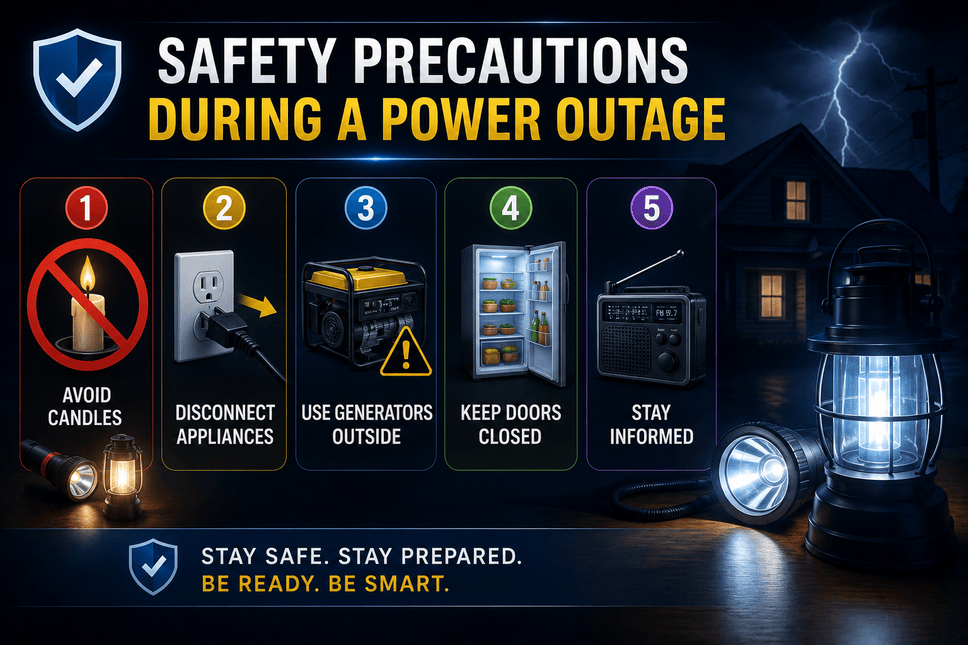
A power outage creates a specific set of hazards that are entirely preventable with the right approach. These five precautions address the most common causes of outage-related injury and damage:
-
1
Choose battery-powered LED lighting — not candles
Candles cause house fires. This is not a remote risk — it is a well-documented pattern every time there is an extended power outage. Battery-powered LED lanterns and flashlights provide safer, brighter, and longer-lasting illumination with none of the fire risk. If you own candles, they belong in a drawer, not on a windowsill during a Squamish windstorm. -
2
Disconnect major appliances before power is restored
When utility power returns after an outage, it does not always come back smoothly. Power surges on restoration are common and can damage or destroy sensitive appliances — refrigerators, washing machines, televisions, computers, and anything with a microprocessor. Disconnect major appliances during the outage and reconnect them one by one once power has been stable for a few minutes. -
3
Run portable generators outdoors only
Carbon monoxide poisoning from generators used in garages or partially enclosed spaces kills people every year during power outages. Portable generators must be run outdoors, positioned away from windows, doors, and vents. If you want safe integrated backup power for your Squamish home, a permanently installed standby generator connected by a licensed electrician is the right solution. Our generator installation service → -
4
Keep the fridge and freezer closed
A refrigerator with the door kept closed maintains a safe temperature for approximately four hours. A full, closed freezer holds its temperature for around 48 hours — a half-full freezer for about 24. Every time you open the door, you are borrowing time from that window. Stay updated through your battery-powered radio rather than checking the freezer to see if things are still frozen. -
5
Monitor updates from local authorities
A battery-powered radio gives you access to District of Squamish emergency communications and BC Hydro restoration updates without depending on a phone that may be losing charge. Keep it in the emergency kit with the batteries tested.
Blackout Procedures — What to Do When the Lights Go Out

Having a clear sequence of steps means you are not making decisions under stress in the dark. Work through these in order:
-
Stay calm and reassure family members
Children and elderly household members can find sudden darkness genuinely frightening. Get the flashlights out first, distribute them, and take a moment before doing anything else. Decisions made in the first 30 seconds of a blackout are rarely the best ones. -
Check the main electrical panel
Determine whether the outage is specific to your home or affecting your neighbourhood. If the panel has tripped breakers, reset them cautiously. If your neighbours are also dark, the issue is with the utility. If only your home is affected, call a licensed electrician before resetting anything. (604) 239-3084 -
Report the outage to BC Hydro
Call BC Hydro's outage line at 1-888-BCHYDRO (1-888-224-9376) or use their online outage map to report and monitor restoration progress. This also helps BC Hydro prioritize their response — an unreported outage is an unscheduled one. -
Turn off and disconnect major appliances
Switch off and unplug significant appliances — refrigerator excepted, which should stay plugged in but leave the door closed. Reducing the electrical load on restoration protects both your appliances and the broader grid from surge damage. -
Use safe alternative heat sources
Squamish temperatures can drop significantly, particularly in winter. Blankets, sleeping bags, and layered clothing are the safest heat sources during an outage. If using a gas heater, ensure the space is properly ventilated. Never use a barbecue, camp stove, or charcoal heater indoors — carbon monoxide risk applies to these as much as to generators.
Lighting Alternatives That Actually Work
The difference between a comfortable and an uncomfortable outage often comes down to how well-lit your home is. These are the options worth having before the power goes out:
Battery-Powered LED Lights
LED lanterns and flashlights are the primary recommendation — bright, long-lasting on a set of batteries, and available in area-illuminating designs that light a room rather than just a beam. Keep multiple units charged and distribute them around the house so they are accessible in the dark.
Solar-Powered Lanterns
Solar lanterns charge during daylight hours and provide sustained illumination through the evening. For multi-day outages — which are not uncommon following major Squamish storms — solar lanterns that recharge each day are particularly practical. Keep them near a window during the day.
Hand-Cranked Flashlights
Hand-cranked flashlights require no batteries and work regardless of how long since you last thought about them. A few minutes of cranking provides usable light. Not the brightest option, but useful as a backup when batteries have run out — which they do.
Recovery Plan — Getting Back to Normal

When power is restored, resist the impulse to just switch everything back on and get back to normal immediately. A few minutes of methodical restoration protects your appliances and gives you useful information about how your electrical system handled the outage.
-
Inspect appliances before reconnecting them
Check for any visible signs of damage — scorching, discolouration, unusual smells — before plugging major appliances back in. Reconnect them one at a time rather than all at once, and allow a few minutes between each to let the system stabilize. -
Assess your food safety
Use the 4-hour refrigerator and 48-hour freezer guidelines as your reference. If you are uncertain whether food has been at a safe temperature, the general principle applies: when in doubt, throw it out. Food poisoning adds a very unpleasant second chapter to what was already a difficult day. -
Restock the emergency kit
Replace any supplies used during the outage — batteries, water, food. Do it now, while the experience is fresh and before the next outage catches you with a depleted kit. -
Consider backup power upgrades
If this outage was long enough or disruptive enough that you wish you had backup power, now is the right moment to act on that. Standby generators, battery backup systems, and EV-to-home power connections are all options worth discussing with a licensed electrician while the memory is still vivid. Our generator installation service → | Call us: (604) 239-3084 -
Review and update your emergency plan
What worked and what did not? Was the emergency kit in the right place? Did everyone know the blackout procedure? A five-minute post-outage review while the specifics are fresh produces a much better kit and plan for next time. -
Book an electrical assessment if anything seemed wrong
If breakers tripped, appliances behaved unusually, or there were any burning smells during or after the outage, have your electrical system assessed before the next storm season. Our electrical inspection service → | Troubleshooting & Repair →
Related services and reading:
Need a Licensed Electrician in Squamish? Call Before the Next Storm.
Kato Electrical serves Squamish and the Sea-to-Sky corridor — generator installation, panel upgrades, surge protection, and electrical inspections. Licensed, insured, A+ BBB rated.
Also Serving Nearby Areas
Common questions about power outages in Squamish — answered by our licensed electricians.