
A Comprehensive Guide to LED Lights, Common Causes of Damage, and Expert Repair Strategies
A Comprehensive Guide to LED Lights, Common Causes of Damage, and Expert Repair Strategies
LED lighting is one of those upgrades that sounds boring on paper and then turns out to be one of the best decisions you ever made for your electricity bill. Most people switch reluctantly — because a bulb burned out and LEDs were the only option at the hardware store — and then wonder why they didn't do it sooner.
Our electricians at Kato Electrical have installed LED lighting systems in homes and businesses across Vancouver and the Lower Mainland for years. We have seen the failures, the flickering, the overheating, and the miraculous electricity bill improvements. This guide covers everything you actually need to know — without the textbook filler.
How LED Lights Actually Work
LED stands for Light-Emitting Diode — which sounds like something you'd find in a university physics exam, but the practical concept is straightforward. At the core of every LED bulb is a diode: a tiny semiconductor component with a positive side (anode) and a negative side (cathode).
When electricity passes through the semiconductor, positive and negative charges meet at a junction. The energy released at that meeting point comes out as photons — light. The material the semiconductor is made from determines what color that light is. No filament to burn out, no gas to deplete. Just electrons doing their thing.
The efficiency advantage comes from what happens to that energy. An old incandescent bulb converts about 10% of the electricity it draws into visible light; the other 90% becomes heat. *(Ten percent. That's not a lighting fixture — that's a space heater that also happens to illuminate the room a little.)* An LED converts the majority of its energy directly into light, which is why they run cooler, last longer, and cost less to operate.
A typical 60-watt incandescent bulb produces about 800 lumens of light. An LED doing the same job draws roughly 8–10 watts for the same output. Over a year of normal use, that one bulb swap saves around $10–$15 in electricity. Multiply that across every fixture in your home and you start to see why people get evangelical about LED lighting at dinner parties.
Types of LED Lights
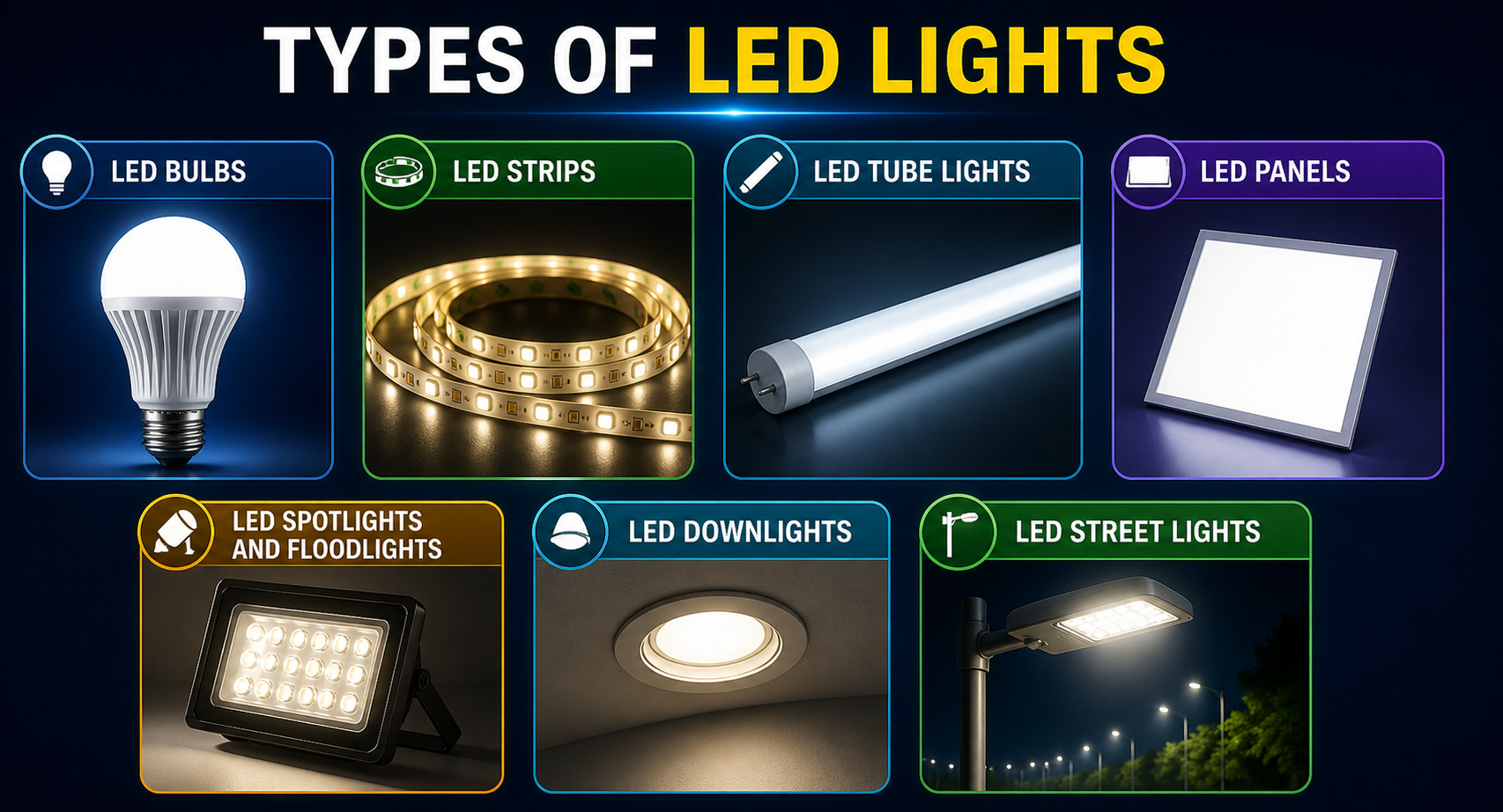
LED technology has evolved far beyond the simple replacement bulb. Here are the main types you will encounter — and where each one actually belongs.
LED Bulbs
The straightforward drop-in replacement for incandescent and CFL bulbs. Available in the same sizes and base types as traditional bulbs — most homes can swap these without any electrical work.
LED Strip Lights
Flexible strips of closely-spaced LEDs used for accent lighting, under-cabinet lighting, and decorative applications. Adhesive-backed and cuttable, they are one of the most versatile LED formats — though proper power supply sizing matters.
LED Tube Lights
LED replacements for fluorescent tube fixtures. Commonly used in offices, kitchens, and commercial spaces. Some are plug-and-play; others require bypassing the fluorescent ballast — which needs an electrician. (Attempting to bypass a ballast yourself is a great way to spend an afternoon you will not enjoy.)
LED Panels
Thin, flat fixtures that replace ceiling grid lights in offices and commercial spaces. They provide even, shadow-free illumination across a wide area — a significant upgrade from the flickering, buzzing fluorescent grids they replace.
LED Spotlights & Floodlights
Directional LED fixtures for highlighting specific objects or illuminating large outdoor areas. Used in track lighting, retail displays, stadium lighting, and outdoor security applications.
LED Downlights
Recessed or pot lights — the standard choice for modern home construction across Vancouver. Installed into the ceiling for a clean, flush look with focused overhead light. Available in a wide range of color temperatures to match the mood of each room.
LED Street Lights
High-output exterior lighting for roads, parking lots, and public spaces. Dramatically more energy-efficient than the sodium vapor lamps they have replaced across most of Metro Vancouver in recent years.
Why LED Lights Are Worth the Switch
-
Energy Efficiency That Actually Shows Up on Your Bill
LEDs consume 75–80% less electricity than incandescent bulbs producing the same light output. For a home in Vancouver running electricity at BC Hydro rates, switching the whole house to LED typically reduces lighting costs by hundreds of dollars per year. Not enough to retire early, but enough to notice. -
Durable — More Than You Would Think
Unlike incandescent bulbs, LEDs have no fragile glass envelope or thin tungsten filament waiting to snap. They are solid-state devices — resistant to shocks, vibrations, and external impacts. You can install them in garages, workshops, and outdoor fixtures without worrying that a slammed door will kill them. -
Design Flexibility That Did Not Exist Before
LEDs are available in shapes, sizes, and color temperatures that incandescent technology could never match. Warm white for living rooms, cool daylight for home offices, tunable white that shifts throughout the day — the control available with modern LED systems and dimming has transformed what residential lighting can do. -
No Toxic Materials
Fluorescent bulbs contain mercury — which means they require specific disposal and create environmental risk if broken. LEDs contain none of that. They can go in standard recycling streams and do not create a hazmat situation if one breaks in your kitchen. -
Lifespan That Makes Replacement Basically Optional
Quality LEDs are rated for 50,000 to 100,000 hours of operation. An incandescent bulb manages about 1,000. A fluorescent tube, roughly 10,000. Installing a good LED in a properly ventilated fixture means you are probably never changing that particular bulb again. (Which is both economically great and slightly unsatisfying for anyone who finds a good stepladder-and-bulb-swap oddly therapeutic.)
Applications of LED Lights
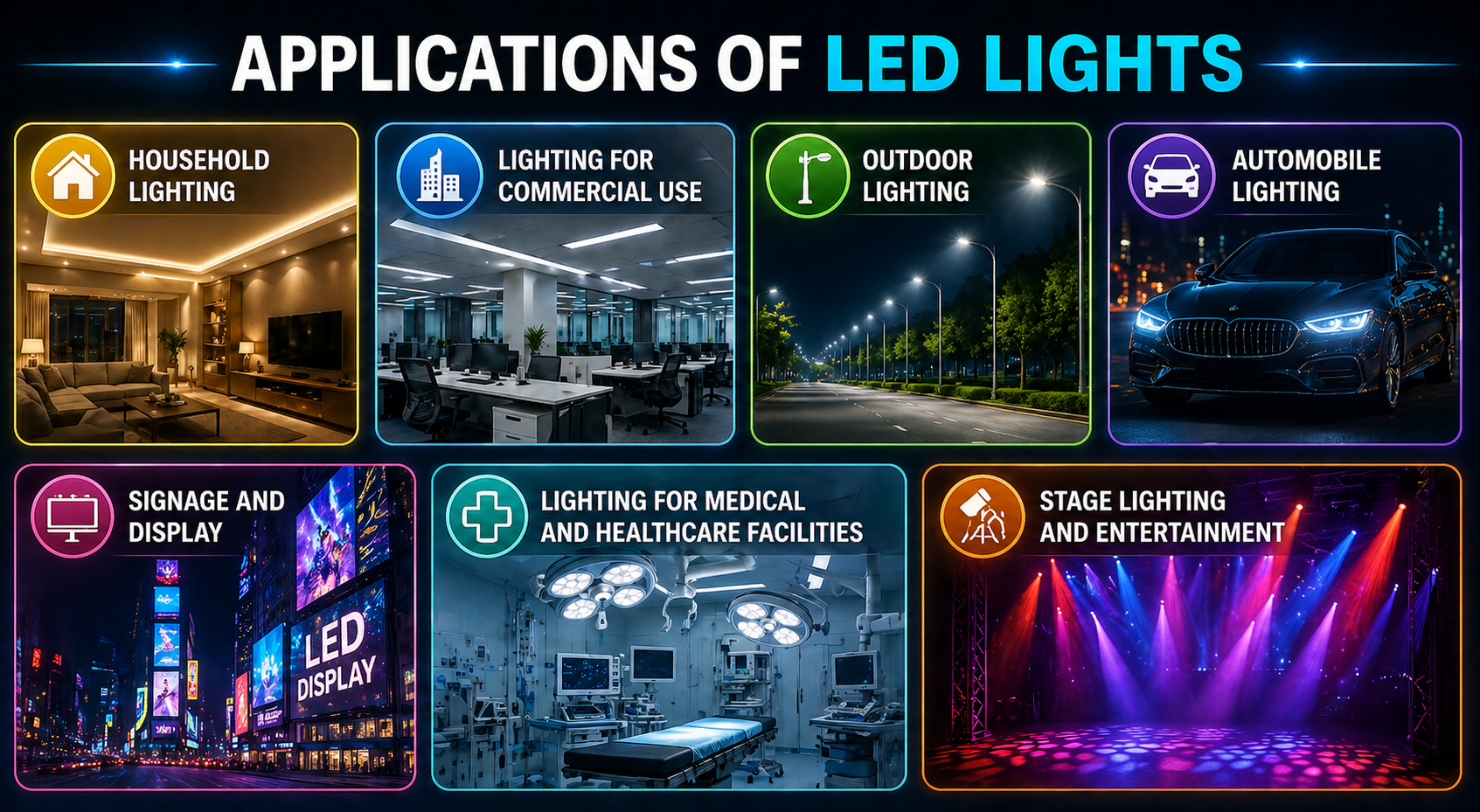
Household Lighting
General illumination, task lighting for kitchens and home offices, accent lighting for artwork and shelving, and decorative lighting for living spaces. LED pot lights and under-cabinet strips have become the default choice in new Vancouver home construction.
Commercial Buildings
Offices, retail stores, hotels, and restaurants rely on LED lighting for general illumination, signage, display cases, and architectural accents. LED retrofit projects are among the most common commercial electrical jobs our team handles.
Outdoor Lighting
Street lighting, parking lots, pathway illumination, and landscape lighting. LED outdoor fixtures have longer service cycles and lower maintenance costs than the halogen and sodium vapor systems they replace.
Automotive
Headlights, taillights, brake lights, and interior lighting in modern vehicles. LED automotive lighting provides better visibility, uses less power from the vehicle's electrical system, and lasts significantly longer than halogen alternatives.
Medical & Healthcare
Operating rooms, examination rooms, and medical instruments require accurate, high-CRI lighting that renders colors faithfully. LEDs with high Color Rendering Index ratings have become the standard in clinical settings where color accuracy affects diagnosis.
Stage & Entertainment
Theaters, concert venues, and event spaces use LED systems for their color range, dimming precision, and reduced heat output. A stage that used to cook performers under tungsten lights now runs cooler and with greater control.
Why Do LED Lights Get Damaged?
LEDs are durable — but "durable" does not mean "indestructible." When they fail prematurely, it is almost always one of the following causes. Worth knowing, because the fix is usually straightforward once you identify the right culprit.
Power Fluctuations
Voltage spikes and fluctuations from the grid can stress LED components. This is especially common during storms or when large appliances on the same circuit cycle on and off. A whole-home surge protector at the panel is the most effective defence.
Heat Buildup
The single most common cause of early LED failure. LEDs produce heat that must escape through the fixture and surrounding air. Enclosed, airtight fixtures trap that heat, raising operating temperatures far beyond the bulb's design spec. Always check whether a fixture is rated for enclosed use before installing an LED.
Moisture and Environment
Exposure to moisture, humidity, dust, or corrosive elements can damage internal circuitry — particularly in outdoor or bathroom fixtures. Always match the IP (Ingress Protection) rating of the LED to the environment it is going into.
Overdriving
Applying too much voltage or current — often through an incompatible driver or dimmer — pushes components beyond their rated limits. The LED runs hotter than designed, degrades faster, and fails earlier. This is a common side effect of leaving old incandescent-era dimmer switches in place after an LED retrofit.
Poor Installation or Wiring
Faulty wiring, loose connections, or incorrect installation can interrupt electrical flow or create points of resistance that generate heat. If an LED dims or flickers and the bulb swap does not fix it, the wiring is the next thing to check.
Counterfeit or Low-Quality Products
Budget LEDs from unknown manufacturers often omit proper heat sinks and protective circuits. They look identical to quality LEDs in the box and fail dramatically faster in the fixture. (If a 10-pack of "LED bulbs" costs $3.99 on a website you have never heard of, the laws of physics suggest this will not end well.)
The most common LED complaint we get is "they keep burning out, and they are supposed to last forever." Almost without exception, the cause is heat — either an enclosed fixture with no ventilation, or a dimmer switch that is not compatible with LEDs. Both are easy fixes. The bulb is rarely the problem. Call us: (604) 239-3084
How to Repair or Troubleshoot LED Lights
Most LED problems are diagnosable without specialized equipment. Work through these steps before deciding a fixture needs replacing entirely.
-
1
Check the power supply first
Sounds obvious. Do it anyway. Test the outlet or switch with another device. Check whether other lights on the same circuit are working. A tripped breaker or faulty switch is responsible for a surprising number of "my LED is dead" calls. -
2
Try a different bulb
If the fixture has a replaceable bulb, swap it with a known-good LED. If the new bulb works, the old one has failed — straightforward replacement. If the new bulb also has issues, the problem is the fixture, driver, or wiring — not the bulb. -
3
Check for overheating
Feel the fixture casing after the light has been on for 20 minutes. If it is too hot to hold your hand on comfortably, heat dissipation is inadequate. Check whether the fixture is rated for enclosed use. Consider switching to a lower-wattage bulb or opening up the fixture for better airflow. -
4
Inspect and tighten connections
Loose connections in the fixture or switch box cause flickering and intermittent failure. Turn off the circuit breaker before opening any junction box. Check that all wire nuts are secure and that no wires have worked loose from terminals. -
5
Check dimmer compatibility
If the light flickers when dimmed, or the dimmer makes a buzzing sound, the dimmer is almost certainly not LED-compatible. LED dimmers require a minimum load and work differently from incandescent dimmers. Replacing the dimmer with an LED-rated model is usually a $30–$50 fix that solves the problem immediately. -
6
Clean the fixture
Dust accumulation on heat sinks and inside fixtures acts as insulation, trapping heat. Disconnect the power, wait for the fixture to cool, then gently vacuum or wipe down the interior. It takes five minutes and can meaningfully extend the life of the remaining LEDs. -
7
Call a licensed electrician for anything beyond the above
LED fixtures with integrated drivers, smart lighting systems, and fluorescent ballast bypass work all involve electrical connections that require a licensed electrician. If the troubleshooting steps above have not resolved it — or if you are at all uncertain — that is what we are here for. Call us: (604) 239-3084
LED Upgrades Worth Considering
If you are already switching to LED, there are a few upgrades that make the investment go further.
Adding smart lighting controls — dimmers, motion sensors, or timers — to an LED retrofit is the right time to do it, while the fixtures are being touched anyway. Smart controls let you schedule lighting automatically, dim for different activities, and reduce energy consumption further. Many BC Hydro rebate programs now cover smart lighting controls alongside the LED fixtures themselves.
Color Rendering Index (CRI) measures how accurately a light source renders colors compared to natural daylight. Standard LEDs typically have a CRI of 80 — adequate for most applications. High-CRI LEDs (90+) make colors appear noticeably more vivid and accurate, which matters in kitchens, art spaces, retail displays, and anywhere you want to actually see what you are looking at. Worth the small additional cost in rooms where color accuracy matters.
Tunable white systems allow the color temperature of your lighting to shift between warm white (2700K, relaxing) and cool daylight (5000K, alert) — either manually or automatically throughout the day. This is particularly useful in home offices and bedrooms where you want different lighting energy at different times. A circadian rhythm lighting system sounds fancy until you realize it just means "the lights get warmer when it is time to wind down."
Related services from our team:
Related reading: Why LED Lighting Upgrades Are Worth the Switch | Slash Your Lighting Costs by Up to 70% with BC Hydro Rebates | Your Guide to Home Automation Systems | Lighting the Path to Sustainability: Vancouver's Shift to Energy Efficiency
↑ Back to topReady to Upgrade Your Lighting in Vancouver?
Our licensed electricians handle LED retrofits, smart lighting installation, and fluorescent replacements across the Lower Mainland — with upfront pricing and BC Hydro rebate guidance included.
Serving All of Greater Vancouver
Common questions about LED lighting — answered by our licensed Vancouver electricians.