
Is it Really Necessary to Use the Bath Fan in the Winter?

Do You Really Need to Run Your Bathroom Fan in Winter? A Vancouver Electrician's Honest Answer
Every winter, the same debate surfaces in Vancouver homes: the bathroom is steaming up, the mirror is fogged, and someone in the family is firmly convinced that the exhaust fan either must be on, or absolutely must not be. The truth — as with most things in ventilation — sits somewhere in between, and depends a lot on how dry your home already is.
Our electricians at Kato Electrical install, replace, and troubleshoot bathroom exhaust fans across Vancouver and the Lower Mainland regularly. This guide gives you the practical answers — including the ones that might surprise you — so you can stop arguing about it and get on with your shower.
Reasons Why People Run the Bathroom Fan

There are three legitimate reasons why bathroom exhaust fans exist and why people use them. All three are valid — but each comes with a nuance worth understanding.
Moisture and Mold Prevention
When you shower, the warm water creates steam that saturates the air. That moisture lands on cold surfaces — the walls, the mirror, the grout lines — and if it is not removed, it creates the conditions that mold needs to grow. Bathroom exhaust fans are designed to pull that humid air out of the room and exhaust it outside before condensation can take hold. (Mold is one of those houseguests that, once established, really does not take hints.)
Odour Removal
Bathrooms produce odours that most households prefer not to linger. An exhaust fan pulls that air out and replaces it with fresh air drawn in through door gaps and ventilation paths. For homes where air fresheners are either allergic territory or simply not preferred, the exhaust fan is the most effective and least chemical-dependent solution.
General Ventilation
In a well-sealed modern home, bathrooms without exhaust fans can become stuffy and poorly ventilated — particularly in rooms without windows. The exhaust fan contributes to the broader air circulation of the home, ensuring that stale, humid air does not simply recirculate. According to Natural Resources Canada's residential ventilation guidelines, bathrooms are one of the primary sources of indoor moisture generation in Canadian homes, making mechanical ventilation particularly important.
Do You Actually Need It Running in Winter?
Here is the part that surprises most people. Winter air in Vancouver — and inside a heated Vancouver home — is already significantly drier than summer air. Your heating system, whether forced air, baseboard heaters, or a heat pump, actively removes moisture from the air as a byproduct of warming it. This is why skin gets dry, wood furniture creaks, and static electricity becomes a small daily adventure in January.
That context changes the maths on the exhaust fan somewhat. If you exhaust every shower's worth of moisture out of the house during winter, you are removing humidity the house's occupants could actually benefit from. Many homeowners invest in a humidifier specifically to restore indoor humidity levels that their heating system has dried out. Running the exhaust fan to remove moisture, and then running a humidifier to replace it, is — let's call it what it is — buying a problem and then buying the solution to the problem.
You do not need to run the fan for every winter shower. On a typical cold, dry winter day, a short shower in a well-ventilated bathroom with the door cracked open may not require the fan at all — particularly if you wipe down the mirror and walls afterward. For longer, steamer showers, or in bathrooms without windows, the fan is still the right call. The goal is moisture management, not moisture elimination. Health Canada recommends keeping indoor relative humidity between 30% and 55% year-round — a range that accounts for both mold prevention and comfort.
How to Use Your Exhaust Fan in Winter
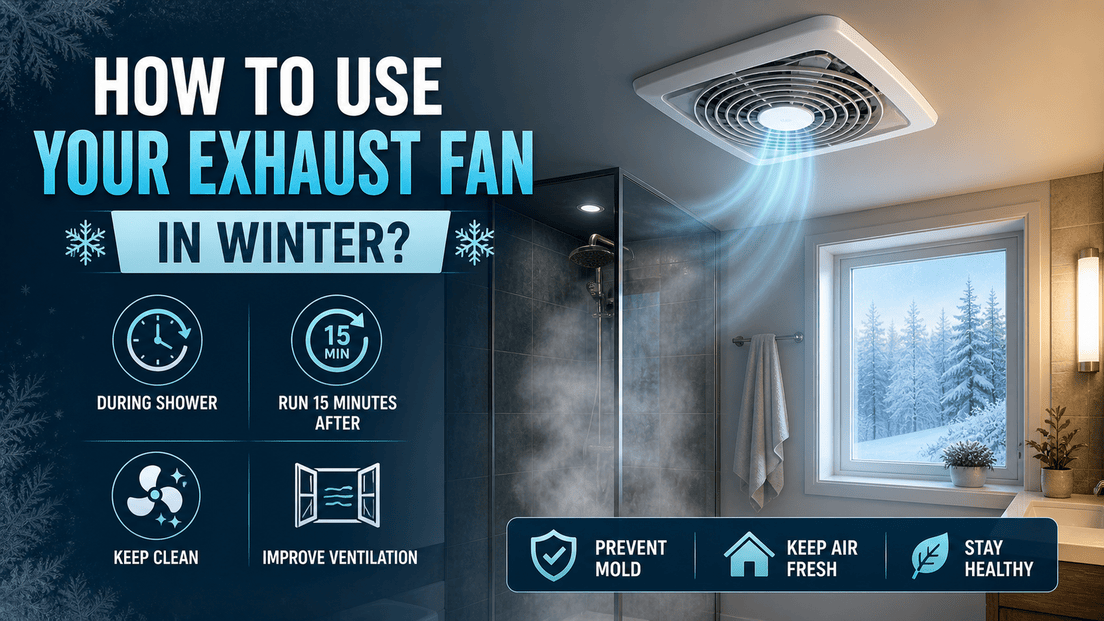
When you do use the fan in winter, the difference between using it correctly and incorrectly is significant. Most households fall into the "switch it off the moment the shower ends" category — which leaves a substantial amount of humid air in the room and defeats much of the purpose. Here is how to actually get the job done.
-
Run it during the shower and for 15 minutes after
This is the standard recommendation from ventilation engineers, and it works. Switching the fan off the moment you turn the water off leaves the bulk of the humid air still in the room — the air you created during the shower is still sitting there, just waiting to condense. The 15-minute post-shower window removes most of the remaining moisture before it can settle on cold surfaces. A timer switch makes this automatic — you do not have to remember to turn it off. We install fan timer switches → -
Crack the door or open the shower curtain
An exhaust fan creates negative pressure in the bathroom — it pulls air out and replacement air needs to come in from somewhere. If the bathroom is completely sealed (door closed, shower curtain fully drawn), the fan has nothing to pull against and its effectiveness drops significantly. Cracking the door slightly or opening the shower curtain gives the fan the air exchange path it needs. Your curtains will also dry faster this way, which reduces the chance of mold developing on the fabric itself. -
Open the window if you have one
A bathroom window cracked open while the fan runs dramatically improves ventilation efficiency. In winter, yes — this means briefly letting some cold air in. The trade-off is faster moisture removal and a drier bathroom, which is worth the 15 minutes of slightly cooler air. Close it once the fan has done its work. -
Clean the fan every six months
Dust accumulates on fan blades and housing over time, reducing airflow and making the motor work harder than it was designed to. A fan running at 70% efficiency due to dust buildup is not doing the ventilation job you think it is doing. Every six months, switch off the circuit breaker, remove the cover, vacuum the blades and housing, wipe down with a damp cloth, and replace. It takes 10 minutes and extends the life of the motor significantly. (This is the maintenance task that everyone means to do and nobody schedules — put it in your calendar right now while you are reading this.) -
Consider a timer switch or humidity sensor
Smart exhaust fan switches can either run the fan on a set timer after the light switches off, or use a built-in humidity sensor to run the fan only when the bathroom's humidity level exceeds a threshold — and switch off automatically once it returns to normal. This removes the human variable entirely. Your fan runs for exactly as long as needed and no longer. Our home automation services include smart fan controls →
The most cost-effective bathroom fan upgrade we install is a simple 15-minute countdown timer switch. It costs around $30–$60 in parts and under an hour to install. Every homeowner who gets one immediately stops forgetting to run the fan long enough — because they do not have to remember. It just works. Call us: (604) 239-3084
What to Do If Your Exhaust Fan Stops Working
A bathroom fan that has gone quiet usually has one of a handful of explanations. Work through these before calling an electrician, but know where the line is.
✓ Check the circuit breaker — the fan's circuit may have tripped. Reset it and see if the fan resumes.
✓ Check the switch itself — test whether the switch clicks normally and whether other fixtures on the same switch work.
✓ Clean the fan — a severely dust-clogged fan can seize. Remove the cover, vacuum thoroughly, and try again.
✗ If none of the above works — stop there. A failed motor, a wiring fault, or a failed capacitor all require an electrician.
Bathroom fan replacement is one of the more straightforward electrical jobs — an experienced electrician can typically replace a standard unit in under an hour, including new wiring if the original installation needs updating to current code. BC Electrical Code requires bathroom exhaust fans to vent directly outside (not into an attic or wall cavity), and a replacement is a good opportunity to confirm your existing ducting is correctly configured.
When buying a replacement fan, quality matters considerably more than it might seem. A cheap fan that runs noisily and requires replacement in three years costs more in the long run than a quality unit that lasts fifteen. Our electricians can advise on brands and models that hold up well in BC's climate. Call us: (604) 239-3084
Under the BC Building Code, any bathroom without a window that provides natural ventilation is required to have a mechanical exhaust fan. In most modern homes, even windowed bathrooms benefit from mechanical ventilation given how airtight new construction tends to be. Our electricians can confirm whether your bathroom's current setup meets current requirements. Our electrical inspection service →
Choosing the Right Size Fan for Your Bathroom
This one is simpler than it sounds, and getting it wrong in either direction is more costly than getting it right the first time.
The standard sizing rule is 1.1 CFM (cubic feet per minute) of airflow per square foot of bathroom floor area. For a bathroom with standard 8-foot ceilings, this is a reasonable starting point. For higher ceilings, you need to increase the CFM rating to account for the additional air volume in the room.
| Bathroom Size | Floor Area | Minimum CFM | Recommended CFM |
|---|---|---|---|
| Small (powder room) | Under 40 sq ft | 50 CFM | 50–70 CFM |
| Medium (standard) | 40–100 sq ft | 44–110 CFM | 80–110 CFM |
| Large (ensuite) | 100–150 sq ft | 110–165 CFM | 130–150 CFM |
| High-ceiling bathroom | Any size | Add 20–30% to base CFM | Calculate and round up |
An undersized fan cannot clear moisture effectively — you end up running it longer and still getting condensation in the corners. An oversized fan clears the room faster than necessary and wastes energy, but does not cause harm. When in doubt, round up.
Motion sensor models: the fan activates when you enter the bathroom and runs for a set time after you leave — zero thought required.
Humidity sensor models: the fan responds to actual moisture levels rather than a fixed timer — runs exactly as long as needed.
Combination fan/light: saves a fixture and often comes with a timer built in.
Low-noise fans: rated in sones — 1 sone is quiet enough that most people barely notice it.
Related services from our team:
Related reading: Your Guide to Home Automation Systems | 10 Overlooked Electrical Mistakes Homeowners Make | Spring Electrical Safety Checklist for Vancouver Homeowners
↑ Back to topNeed a Bathroom Fan Installed, Replaced, or Repaired in Vancouver?
Our licensed electricians handle bathroom fan installation, timer switch upgrades, and full bathroom electrical work across the Lower Mainland — with upfront pricing and no surprises.
Serving All of Greater Vancouver
Common questions about bathroom exhaust fans — answered by our licensed Vancouver electricians.